Strange 'centaur' object between Saturn and Uranus has mysterious, changing rings, James Webb telescope study hints
James Webb Space Telescope observations of Chariklo, one of the smallest ringed worlds in the solar system, reveal some inexplicable changes.
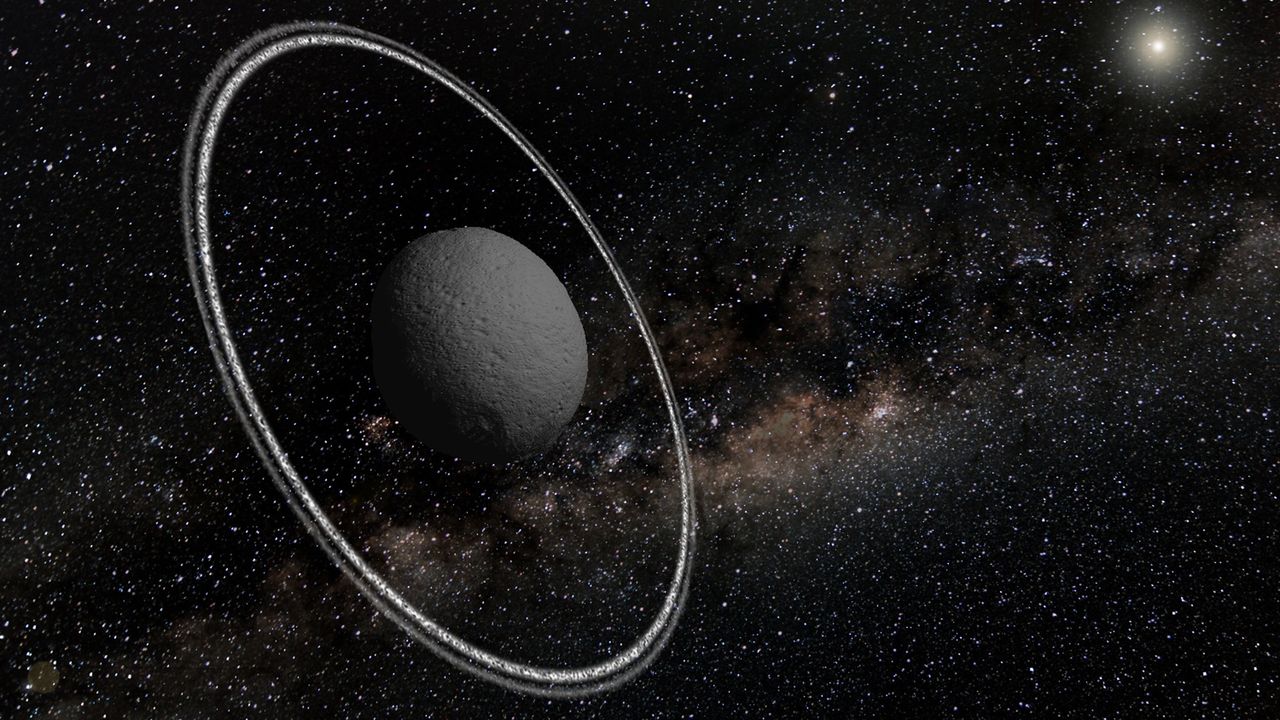
A recent study suggests that a small body, known as a centaur, orbiting between Saturn and Uranus, called Chariklo, has rings that exhibit mysterious and changing characteristics. The rings were first discovered in 2013, making Chariklo the first small solar system body found to have rings. However, new observations from the James Webb Space Telescope (JWST) in 2022 revealed significant differences in the appearance of the rings compared to previous studies.
Pablo Santos-Sanz, a researcher at the Institute of Astrophysics of Andalusia and the lead author of the study, published in Science Advances, stated that the inner ring shows significantly higher opacity, while the outer ring shows lower opacity. The researchers are unsure of the exact cause of these changes, but they have proposed three possible explanations.
Firstly, JWST's high resolution allowed it to detect denser and sparser zones within the rings that were not visible in earlier observations. Secondly, there could have been changes in the material or grain composition within the rings themselves. Lastly, it is possible that JWST could see grains with wavelength-dependent optical properties, which would explain the variability in the rings' appearance.
Santos-Sanz emphasized that these findings suggest that small bodies with rings, even those orbiting far away from the gravitational influences of planets, may undergo more changes in their systems than previously thought. The researchers believe that their results force a reevaluation of how these bodies form, evolve, and maintain their ring systems' stability.
To further confirm their findings and better understand the temporal evolution of Chariklo's rings, the researchers propose conducting a theoretical observation during the next time the centaur passes in front of a star. This observation would help differentiate between real changes in the rings and wavelength-dependent scattering effects, thereby clarifying the physical processes shaping Chariklo's rings.
Written by urgent.news from Live Science's reporting — not their text. Machine-written — may contain errors; check the original before relying on it.
This story
This is one outlet's version. Read the fullest account.