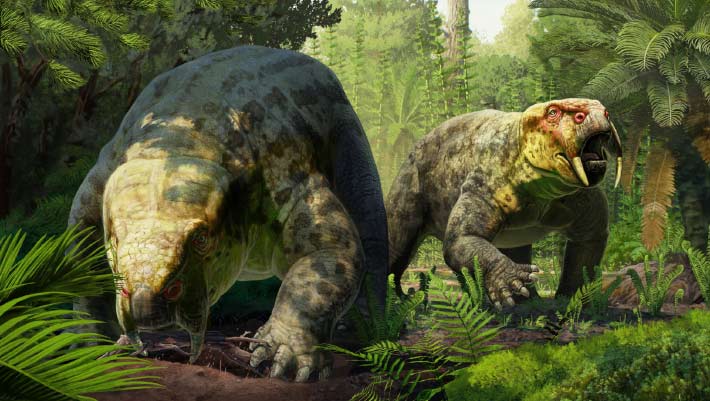
New species of 240-million-year-old prehistoric animal could reshape dinosaur origins timeline
A new prehistoric animal species from Tanzania dating to around 240 million years ago, during the Triassic period, has been described by an international team of researchers. Led by the University of Bristol, the new species, named Dinodontosaurus isiyavamanda, could help scientists refine the age of one of the world's most significant fossil sites and reshape the timeline of early dinosaur…

In 1963, a British expedition discovered a vast collection of synapsid fossils in Tanzania during the Triassic period. These fossils, now held at the Natural History Museum in London, comprised a group of herbivorous synapsids known as dicynodonts. Recently, researchers from the University of Bristol, led by Ph.D. student Hady George, reexamined one of the unidentified skeletons from this collection in conjunction with a fragmentary skull.
Their analysis revealed the fossils belong to a previously unknown species of the genus Dinodontosaurus, which was previously only known from South America. The researchers named this new species Dinodontosaurus isiyavamanda, a reference to the Wamanda people of Tanzania.
The discovery of Dinodontosaurus isiyavamanda has significant implications for our understanding of the early evolution of dinosaurs. Dinodontosaurus isiyavamanda's existence in both Tanzania and South America indicates that these two regions were of equivalent age during the Triassic period. This challenges the previous assumption that Tanzania's fossil beds contained the oldest potential dinosaur fossils.
With new radiometric dating from South America, it is now suggested that the Triassic rocks of Tanzania cannot be considered as preserving the oldest dinosaur candidates, prompting a reassessment of when and where dinosaurs first emerged.
This finding, published in the Journal of Vertebrate Paleontology, underlines the importance of revisiting museum collections for new discoveries. The study also highlights the advancements in techniques, such as micro-CT scanning, which have enabled researchers to examine fossils in greater detail than ever before. Furthermore, the international collaboration involved in this research demonstrates the value of combining expertise across different institutions and nations to further our understanding of Earth's paleontological history.
Written by urgent.news from Phys.org's reporting — not their text. Machine-written — may contain errors; check the original before relying on it.