Election polls can inform voters — or become political weapons
As South Africa heads towards the 2026 local government elections, opinion polls will increasingly shape political narratives. But polls are measurements, not predictions, and their value depends on methodology, transparency and how their findings are interpreted by parties and the media.
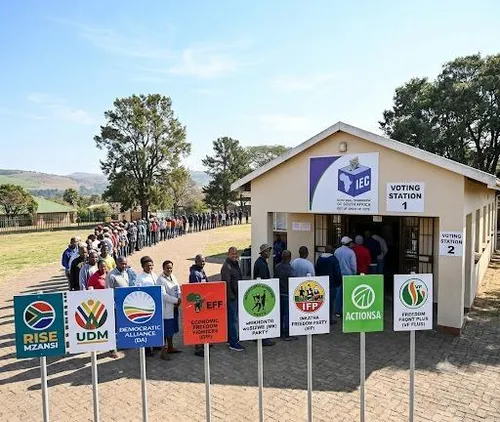
South Africa is preparing for another election season where opinion polls will serve more purposes than merely gauging public sentiment. These polls will not only persuade, reassure, and alarm voters, but also become tools of manipulation. One poll may show the ANC lower than expected, prompting its supporters to question the pollster's credibility before casting doubt on the results.
Conversely, another poll might indicate the DA gaining ground in Johannesburg, leading that party to disseminate the figure before most people have had the chance to scrutinize the methodology. MK will likely capitalize on a positive finding from KwaZulu-Natal as evidence that the old order is still unraveling. Meanwhile, the EFF will dismiss an unfavorable survey as mere establishment propaganda.
Newspapers will turn minor movements within the margin of error into tales of surges, collapses, and political upheavals. The lesson from the 2024 election is clear: polling requires critical thinking. The pollsters were largely accurate in their broad estimates – ANC at 40.18%, DA at 21.81%, MK at 14.58%, and EFF at 9.52%. However, there were errors.
Some surveys were conducted too early to capture late changes, assumptions about turnout were incorrect, and the MK's rapid rise made earlier numbers appear less reliable. Additionally, questions about the independence of pollsters have arisen. These factors do not render polling useless. Rather, a poll is a snapshot taken at a specific moment from a particular sample using a specific method and based on certain assumptions.
Once the polling occurs, the real work begins – interpreting the data and determining what it means for the political landscape. This becomes even more crucial for the 2026 local government elections, as local elections are more challenging to poll than national ones. While a single national local-election poll can provide some insight, it does not necessarily indicate where power will ultimately be concentrated.
Political temptation may arise when a survey shows the ANC at 34% nationally and the DA at 27%, leading people to believe the race is tightening. Yet, it is essential to dig deeper before jumping to conclusions. We need to know who was surveyed – registered voters or likely voters? How was likelihood to vote determined? What methods were used (face-to-face, telephonic, or online)?
How were undecided voters handled? What assumptions were made regarding turnout? And what does a national percentage actually reveal about specific areas like Johannesburg, Tshwane, or eThekwini? The poll is not the entire electorate; it is a photograph taken through a specific lens. Much of the political mischief arises after that.
For instance, margins of error are often relegated to footnotes when they should sometimes be placed closer to the headline. A party might move from 25% to 27% between surveys, with margins of error ranging from two to three points, but the actual movement might be negligible. However, the language attached to those figures can create the illusion of movement where the statistics do not, such as labeling one party as "surging" while another is "bleeding support".
The numbers may not have changed significantly. The real politics often lies in the sentences surrounding the numbers. This is how a poll can become a political instrument without the poll itself being compromised. A favorable survey is published, a party highlights its strongest result, a graphic appears before the methodology is read, supporters circulate it, commentators declare momentum, donors assess viability, and rivals are forced to respond to a narrative they didn't create.
Research intended to measure political reality can inadvertently shape the political environment it is measuring. This does not require fraudulent spreadsheets; skilled interpretation can suffice. South Africa's polling debate often conflates two separate issues: was the research conducted competently and honestly, and how is that research being politically manipulated?
While these questions can overlap, they are not interchangeable. The controversy surrounding the Social Research Foundation and Victory Research serves as a useful example. SRF's final polling before the 2024 election was accurate, placing the DA nearly exactly where it finished, and providing reasonable estimates for the ANC, MK, and EFF.
Discarding the work solely because critics dislike the institutions involved would be intellectually lazy. Nevertheless, it would be equally negligent to overlook those associations as irrelevant. Victory Research, which contributed to SRF's polling, had its founding managing partner, Johan van der Berg, simultaneously serving as the DA's head of research during the 2024 election period.
Gareth van Onselen had previously worked for the DA. These facts do not prove that a single result was manipulated, but they do raise legitimate questions about independence. Statistical accuracy does not absolve research of responsibility. In order to maintain transparency, media organizations and politically connected foundations should clearly disclose their involvement in funding polls.
If a polling company works privately for political parties while also publishing public polling, that relationship should be disclosed. "Internal polling" should not be mistaken for independent research simply because it is re-published by a newspaper. Equally important is addressing concerns about independence. While the ANC would be wise to dismiss an alarming Johannesburg poll result if they distrust the institution producing it, they should not do so blindly. A rational response would be to replicate and compare the findings with other surveys.
Written by urgent.news from IOL's reporting — not their text. Machine-written — may contain errors; check the original before relying on it.
This story
This is one outlet's version. Read the fullest account.