China bets on chips and AI in new 5-year road map to challenge US tech dominance
An intensifying tech race with the United States, along with Beijing’s drive for technological self-reliance, has led China’s leaders to place greater significance and urgency on breakthroughs in sectors ranging from artificial intelligence to integrated circuits and chips in its latest five-year plan for electronics and information technology. The Ministry of Industry and Information Technology…
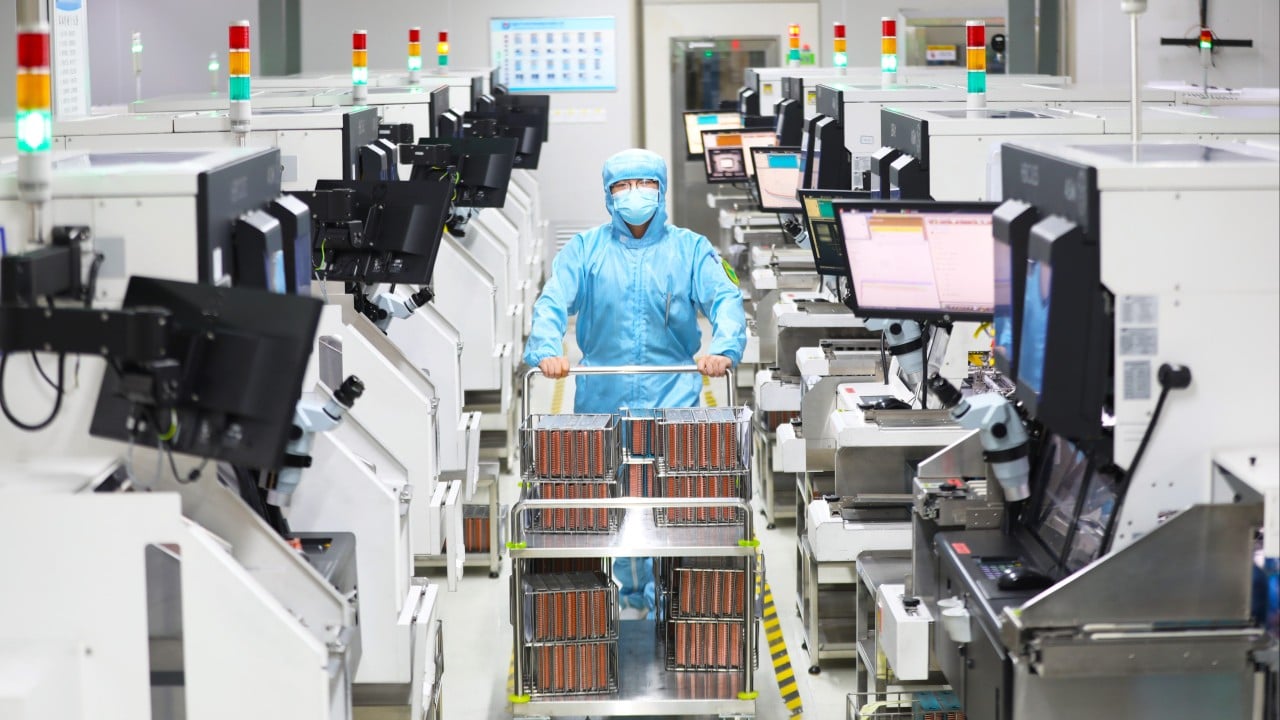
China has launched a new five-year plan to challenge US tech dominance, with a focus on advancing semiconductor and artificial intelligence (AI) technologies. The Ministry of Industry and Information Technology, along with the National Development and Reform Commission, outlined key priorities for the electronics and information technology sector over the next half-decade.
These include substantial progress in integrated-circuit development, particularly the creation of open-standard RISC-V chips, to lessen reliance on Western technology. The plan also emphasizes the BeiDou satellite navigation system as a competitor to the US-led Global Positioning System. China is prioritizing next-generation battery and solar technologies, such as perovskite tandem solar cells, which combine a perovskite layer with conventional silicon cells to enhance sunlight absorption and power-conversion efficiency.
Advanced chip development is central to these ambitions, with a focus on high-end chips, advanced process nodes, and AI compute-power supply capacity. AI is a top priority in the plan, with measures to increase its penetration and adoption, including the development of AI-embedded humanoid robots and autonomous driving systems. The plan also aims to increase the use of next-generation intelligent terminals, such as AI-enabled smartphones, PCs, smart glasses, audiovisual terminals, and in-vehicle terminals.
By 2030, China forecasts operating revenue in related sectors to surpass 30 trillion yuan (US$4.5 trillion), with a competitive edge over foreign rivals in chips, advanced computing, consumer electronics, basic electronic components, and energy electronics. The plan's drafting took over a year, with its release occurring as both China and the US continue their efforts to develop, test, and deploy AI.
US President Donald Trump dismissed AI risks during a live-broadcast panel discussion with Nvidia CEO Jensen Huang, stressing the need to win the geopolitical competition against China. Conversely, China rejected calls to slow AI deployment, emphasizing that global progress must remain open and inclusive.
Written by urgent.news from South China Morning Post's reporting — not their text. Machine-written — may contain errors; check the original before relying on it.