Emerging markets face both promise and disruption from AI: QNB
Artificial intelligence (AI) is rapidly emerging as one of the most transformative economic forces of the era, with its global market projected by UN Trade and Development (UNCTAD) to expand roughly 2...
Artificial intelligence (AI) is set to be a pivotal force in the global economy, with its market expected to grow exponentially to reach approximately $4.8tn by 2033, according to the UN Trade and Development (UNCTAD). For advanced economies, AI holds the promise of significant productivity gains. However, for emerging markets, the implications are more nuanced and dual-edged.
AI can accelerate development, enhance public services, boost industrial expertise, and bypass outdated infrastructure. Yet, it also poses a threat to erode competitive advantages and widen the gap between affluent and impoverished nations, especially in countries with service sectors reliant on low-cost manual and repetitive tasks.
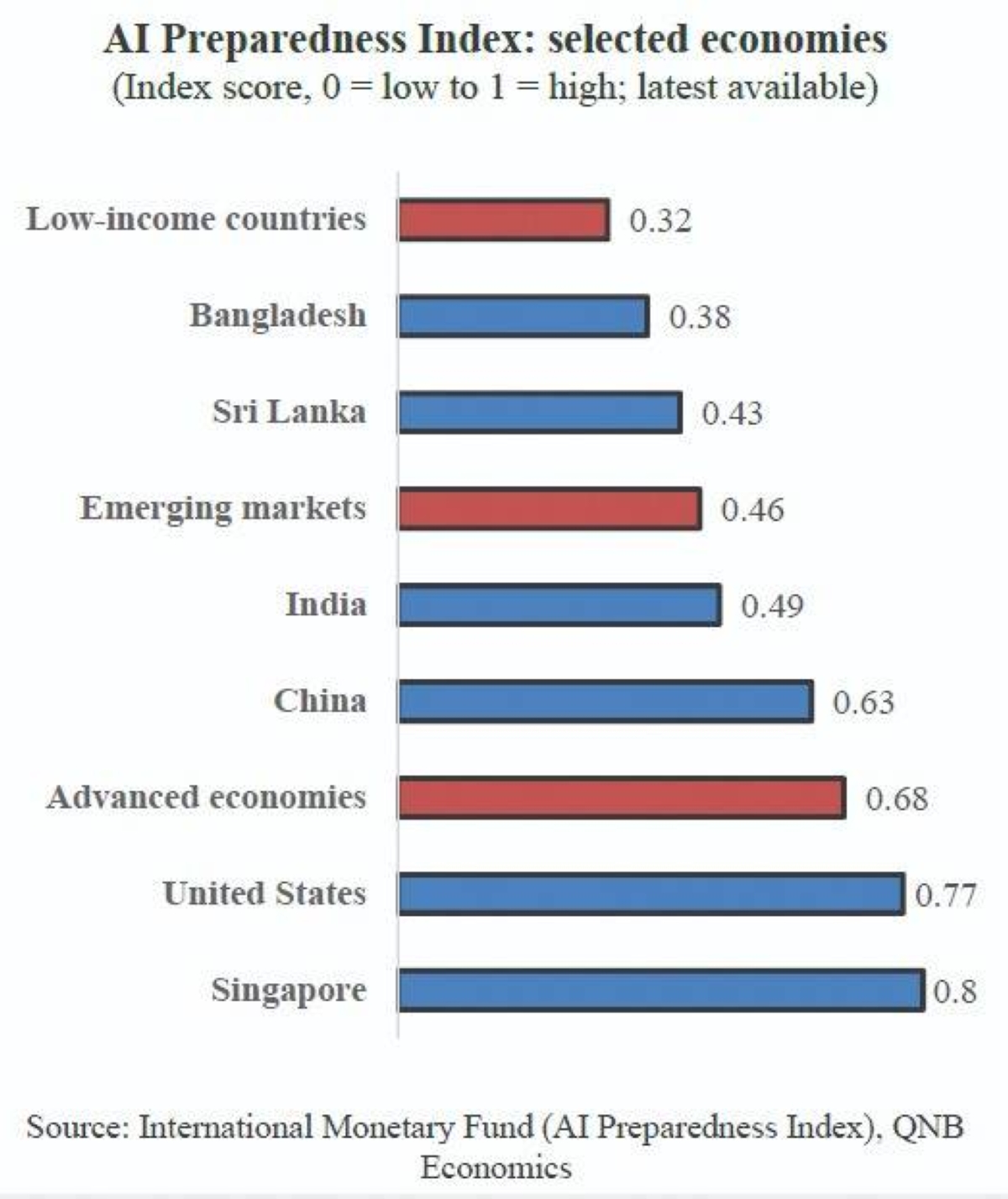
The impact of AI on any economy hinges not only on the technology but also on a nation's ability to adopt and adapt it. Emerging markets face a unique set of advantages and vulnerabilities compared to advanced economies as they navigate this transition. QNB has delved into both facets of AI's impact on emerging markets: the potential for productivity boost and accelerated growth versus the risk of disruption to industries that have been honed over decades.
On the positive side, AI could significantly enhance productivity and hasten development in economies that have struggled with a shortage of skilled labor and uneven institutional capacity. In education, AI translation models could accommodate regional dialects and low-resource languages, diminishing structural barriers to communication.
Personalized tutors could improve access to quality education, tailoring lessons to individual students' skill levels. In healthcare, AI-assisted diagnostics could extend services to rural areas and improve initial diagnosis quality, potentially reducing infant mortality and increasing average life expectancy. In finance, AI-assisted credit scoring leveraging unstructured and behavioral data could expand credit availability in micro-finance for small producers and entrepreneurs while mitigating related credit risks.
On the downside, AI threatens to disrupt labor markets and the development models that have historically supported emerging economies. It is reshaping the economic edge of repetitive remote tasks, moving from labor arbitrage, which relies on low-cost human workers, to algorithm arbitrage, which depends on cheaper AI agents. The International Monetary Fund (IMF) estimates that about 40% of jobs in emerging markets are vulnerable to AI, particularly in industries and services with high levels of manual and routine work.
Generative AI and AI agents can now handle simple cognitive tasks, data processing, and basic billing at a lower cost than employing overseas staff. This trend is already evident in India's $300 billion IT outsourcing industry, where routine junior developer and business process outsourcing roles are experiencing sharp reductions in campus recruitment across Indian technology hubs.
The Nifty IT index, which tracks India's leading software companies, has fallen by around 15% this year, compared to a 20% rise in the broader MSCI Emerging Markets Index, as reported by QNB.
In summary, AI presents emerging markets with both an unparalleled opportunity and a considerable risk. To leverage the opportunity, economies must prioritize the development of digital infrastructure, robust data ecosystems, and workforce skills. Those that prioritize these areas early on may harness AI as a potent engine for catch-up growth. Conversely, those that fail to do so might see the divide between the technological frontier widen further, potentially leading to increased economic divergence in the years to come.
Written by urgent.news from Gulf Times Business's reporting — not their text. Machine-written — may contain errors; check the original before relying on it.