MMRDA Explores Land Tokenisation Under Maharashtra’s Delta Act To Unlock Assets And Fund Mega Infrastructure Projects
The Mumbai Metropolitan Region Development Authority (MMRDA), is looking at land tokenisation as a potential new mechanism to unlock the financial value of its vast land assets and fund major infrastructure projects. Maharashtra May Become First Tokenised State MMRDA Commissioner Dr Sanjay Mukherjee said the proposed land tokenisation framework under Maharashtra’s proposed Delta Act could allow…
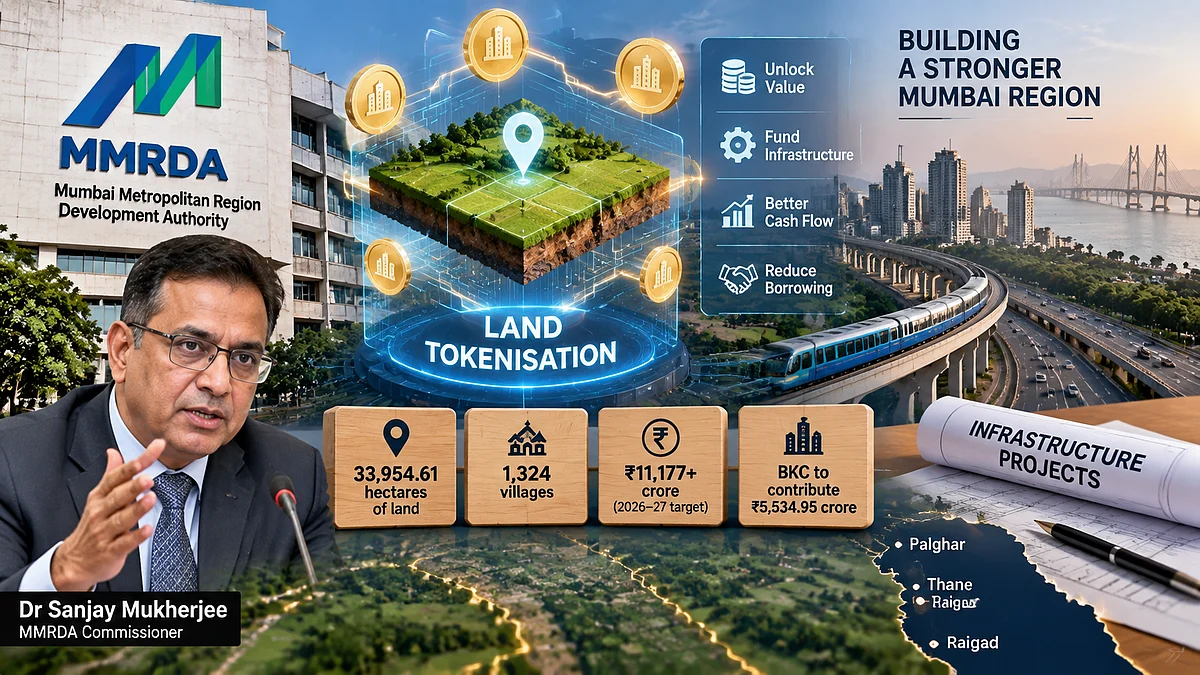
The Mumbai Metropolitan Region Development Authority (MMRDA) is exploring land tokenisation as a potential method to tap the financial worth of its extensive land assets and fund large-scale infrastructure projects. In an interview, MMRDA Commissioner Dr Sanjay Mukherjee revealed that under Maharashtra’s proposed Delta Act, the authority could leverage its land assets more efficiently and unlock value according to the actual funding requirements of its projects.
If implemented, Maharashtra could become the country’s first "tokenised state," according to Mukherjee, with MMRDA being a pioneer in land monetisation. The proposed mechanism could significantly benefit MMRDA, as the authority has acquired 33,954.61 hectares of government land across three districts in recent years. For the fiscal year 2026-27, MMRDA expects to generate over Rs 11,177 crore from land sales and associated charges, with notable contributions from the Bandra-Kurla Complex (Rs 5,534.95 crore) and the Wadala Truck Terminal and Wadala Notified Area (Rs 1,630 crore).
The Karnala–Sai–Chirner New Town Development Authority (KSC NTDA) has a land-related revenue target of Rs 4,000 crore. Conventional land monetisation schemes are currently in place, such as those for the Bandra-Kurla Complex and the Wadala Truck Terminal. The tokenisation mechanism could provide an additional avenue for MMRDA to unlock the value of its land assets without resorting to traditional land sales.
This approach would enable the authority to unlock only the necessary value for executing specific infrastructure projects, strengthening financial management and helping execute projects within timelines. The strategy could reduce MMRDA's reliance on borrowing and assist in achieving financial closure for its extensive project pipeline.
Written by urgent.news from Free Press Journal's reporting — not their text. Machine-written — may contain errors; check the original before relying on it.