Hasil Sabah, petroleum Sarawak dan kerusi Parlimen tumpuan mesyuarat MA63
Mesyuarat di Kota Kinabalu pada Jumaat itu menarik perhatian ketika hala tuju politik dan kestabilan kerajaan kerap dibahaskan.
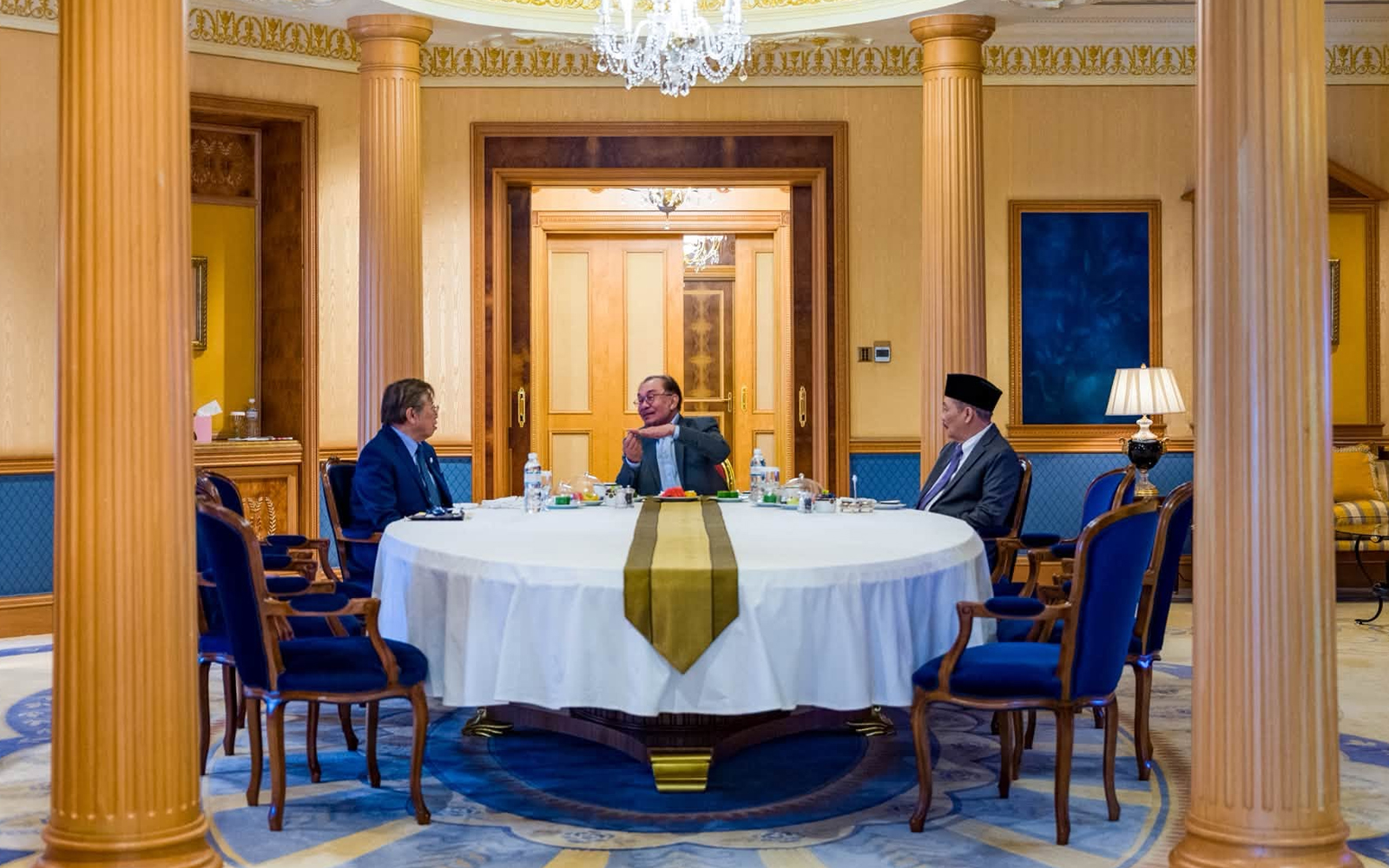
Prime Minister Anwar Ibrahim is set to chair the Malaysia Agreement 1963 (MA63) Implementation Conference in Kota Kinabalu on Friday, with Sabah and Sarawak demanding greater representation in Parliament as their primary focus. The meeting, which comes shortly before Malaysia's National Day celebrations, also saw Sabah Chief Minister Abang Johari Openg and Sarawak Chief Minister Hajiji Noor attending to raise their respective states' concerns.
The discussions coincide with Umno, the ruling party within the Barisan Nasional coalition, discussing its political agenda, including its stance on the unity government, during the party's mega gathering this week. While Umno has not yet decided to leave the government, its move to engage with PAS could make Sabah and Sarawak's relationship with Anwar and the coalition more crucial in maintaining government stability.
Although Umno has not made a decision to withdraw from the government, its re-engagement with PAS highlights the growing importance of Sabah and Sarawak's interests in maintaining political stability. With a greater number of parliamentary seats in Malaysia's East, both states would demand a one-third share in the Dewan Rakyat, based on the original distribution when Malaysia was formed in 1963.
This demand stems from the original allocation of 55 seats, or roughly 34%, to Sabah, Sarawak, and Singapore, designed to prevent the Peninsula from gaining a two-thirds majority and potentially unilaterally amending the Constitution.
However, political analyst Awang Azman Pawi from the University of Malaya notes that Sabah and Sarawak have never received a guarantee that they will retain one-third of the parliamentary seats after Singapore's departure from Malaysia. According to him, this current demand reflects the desire of the East Malaysian states to move from merely acting as 'kingmakers' to securing a more robust and structural influence in Putrajaya, rather than merely capitalizing on political tensions on the Peninsula.
Political analyst James Chin from the University of Tasmania suggests that an increase in parliamentary seats for Sabah and Sarawak may strengthen the relationship between the federal government and the Sarawakian and Sabahan coalition (GPS) and (GRS). "They may be more likely to back Anwar compared to a government heavily influenced by PAS," Chin says from the University of Tasmania.
However, Chin adds that adding more parliamentary seats is unlikely to happen before the end of the year because it requires a constitutional amendment, and must be considered alongside a broader review of electoral reform processes.
The petroleum dispute is expected to be one of the most significant issues discussed at Friday's meeting. Former Law Minister Zaid Ibrahim claimed that discussions could lead to advancements in Petronas' role as the sole gas aggregator in Sarawak, which is estimated to be worth RM10 billion annually. However, he warns that MA63 should not be used as a bargaining chip between political leaders, arguing that the dispute over Petronas' rights should be decided through the courts.
Senator Ahmad Ibrahim dismissed claims that Anwar's talks with Sarawak and Sabah are merely a political exchange involving oil and gas rights. "Discussing is not a sign of weakness, demonstrating respect for the Constitution is not synonymous with giving up and accepting that one's rightful claim is invalid," he says. Ahmad, who is a member of the UN General Assembly, emphasizes that disputes over legislation, such as the Oil Production Sharing Ordinance 1958, the Petroleum Development Act 1974, and other federal statutes, must be resolved through the courts. "If we are to speak about law, let us speak about the law that governs," he says.
Economist Samirul Ariff Othman also agrees that MA63 discussions should not be linked to political motives or premature conclusions about ongoing court cases. He maintains that while Sabah and Sarawak have a legitimate claim to a larger share of the pie, the country's federal, state, and Petronas roles must be clearly defined. "The question is what functions remain at the national level and what is the responsibility of the state — and whether revenue, control, responsibility, and risk also shift in tandem with that distribution," he says.
Samirul adds that Sabah and Sarawak's involvement in the conference is not merely symbolic. "Sabah has already declared its demand for 40% of the net profit, and the technical MA63 process will also address other federal-state issues yet to be resolved," he says. Anwar announced a special allowance of RM1.5 billion to Sabah in May, but the exact amount to be paid in compensation for Sabah's 40% share of the profits has yet to be determined.
Written by urgent.news from Free Malaysia Today's reporting — not their text. Machine-written — may contain errors; check the original before relying on it.
Also reported by 1 other outlet
- Setuju tambah kerusi Parlimen mesti disusuli tindakan, kata menteri Sarawak freemalaysiatoday.com