The moon may have formed in just 5 hours, new simulations suggest
Novel simulations, which reassessed the ancient collision between Earth and the protoplanet Theia, suggest that the moon could have emerged from the aftermath of this impact much more quickly than scientists previously thought.
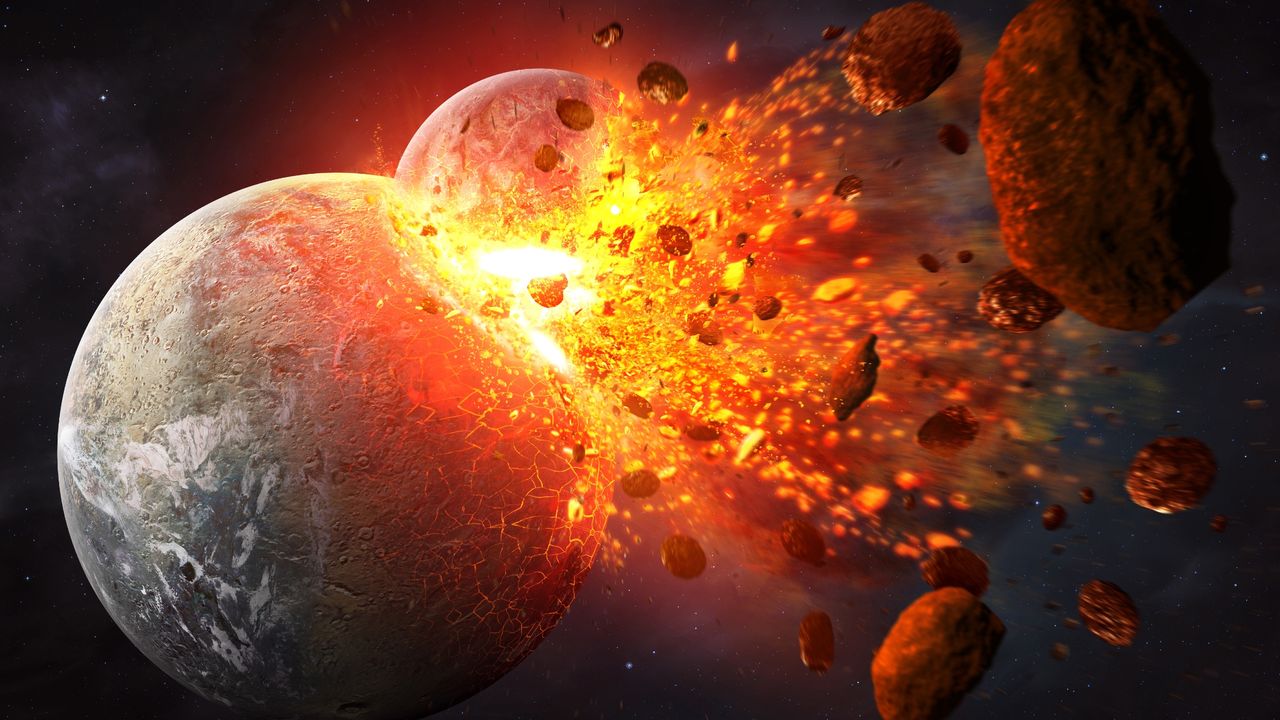
New simulations propose that the moon may have formed in as little as five hours following a collision between Earth and a Mars-sized protoplanet called Theia. This rapid formation could provide insights into other historic impacts in our cosmic neighborhood and beyond. The moon is believed to have originated from a cataclysmic impact around 100 million years after the Sun was born, making it roughly 4.5 billion years old.
The giant impact hypothesis, which posits that the moon formed from the debris of this collision, has been supported by lunar rocks collected during NASA's Apollo missions. However, previous simulations of the Earth-Theia impact have primarily focused on the masses of the colliding bodies, rather than their geological properties.
Researchers from the Southwest Research Institute in Boulder, Colorado, conducted a series of simulations that considered different geological properties of Earth and Theia before their collision. They discovered that, under the right conditions, the moon could have formed in a matter of hours. The strength of the colliding bodies, particularly their surface hardness, emerged as a crucial factor that was previously overlooked.
When the two bodies were at their hottest, their molten surfaces cushioned the impact, allowing the moon to coalesce more quickly. The researchers emphasize that the exact temperature and strength of Earth and Theia at the time of their collision remain uncertain. Nonetheless, these simulations underscore the significance of material strength in planetary impact modeling, potentially shedding light on other ancient collisions and informing the search for exomoons around distant exoplanets.
Written by urgent.news from Live Science's reporting — not their text. Machine-written — may contain errors; check the original before relying on it.
Also reported by 1 other outlet
- The Moon may have formed intact just hours after a giant collision sciencedaily.com


