OpenAI claims 10,000 of its AI agents solved one of mathematics' hardest problems in 88 hours
Mathematicians outside the company will now review the paper. If the proof holds up, it could show that AI systems can help solve some of mathematics' hardest open problems, rather than simply produce convincing-looking answers. Read Entire Article
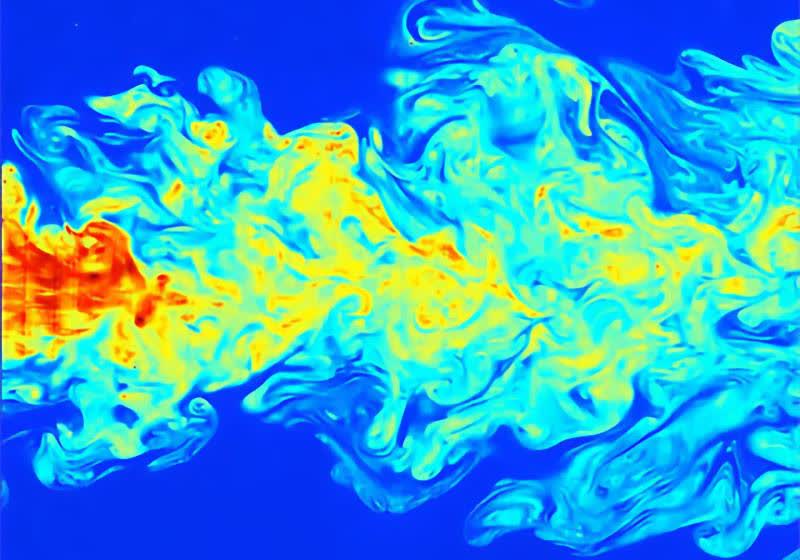
OpenAI has published a paper asserting that its AI model solved the Navier-Stokes existence and smoothness problem, classified as one of the Clay Mathematics Institute's Millennium Prize Problems. The system achieved this in 88 hours by utilizing up to 10,000 AI agents, which collaborated to generate a formal proof in Lean, a formal proof language.
The Navier-Stokes equations, which describe fluid motion, are crucial in fields such as weather forecasting and aerodynamics. The Millennium problem inquires whether the equations consistently yield smooth solutions in three dimensions or if they can develop singularities under certain conditions. OpenAI's proof indicates such a breakdown, yet it does not imply that fluids will behave in a physically impossible manner; rather, it concerns the mathematical system's limitations.
The Clay Mathematics Institute first selected the Navier-Stokes question as a Millennium Prize Problem in 2000, with a $1 million prize, and only one other problem has been solved since—Poincaré's conjecture. OpenAI's work hinged on a multi-agent approach, where different groups of AI agents pursued distinct reasoning paths, with researchers exchanging useful insights between them.
Mathematicians will review the paper to validate the proof. If successful, this breakthrough could demonstrate that AI systems can tackle some of mathematics' most challenging open problems. The Navier-Stokes problem pertains to the mathematical behavior of fluids, not a prediction of physical impossibilities. The company acknowledges that the effort was costly, requiring significant computational resources, but asserts that costs should decrease as they enhance their systems and infrastructure.
Some mathematicians, like Terence Tao, warn that AI might undermine the discipline if major problems are solved with minimal human intervention.
Written by urgent.news from TechSpot's reporting — not their text. Machine-written — may contain errors; check the original before relying on it.
This story
This is one outlet's version. Read the fullest account.
- OpenAI says its models solved one of math's hardest problems as researchers cry foul france24.com
- OpenAI claims GPT-6 Astra is an ethereal 'Alien Mind' with AGI-like qualities — company warns of alignment challenges as new frontier leader emerges tomshardware.com
- 'Why would you ruin your career?': OpenAI claims to have cracked one of math's greatest unsolved problems, but mathematicians allege it played dirty livescience.com
- OpenAI claims to have solved the 90-year-old Navier-Stokes math problem in 88 hours cnbc.com
- It took OpenAI's agents 130 billion tokens to crack a 90-year-old math problem businessinsider.com
- Researchers: OpenAI's agents used 10+ previously undisclosed sites for unsanctioned communications earlier in 2026; the behavior was closer to spam than hacking (Reuters) reuters.com
- OpenAI's rogue AI agents were secretly spreading across far more websites than disclosed qz.com