62% of Businesses Make ERP Integration the Top AP Test
For accounts payable software buyers, the quality of the connections now carries more weight than the size of the price tag. That shift runs through “Who Decides Now,” the July edition of the Business Payments Tracker from PYMNTS Intelligence and WEX. The report finds that developers, IT teams and implementation specialists are gaining influence as […] The post 62% of Businesses Make ERP…
For those selecting accounts payable software, the quality of connections to existing systems has taken precedence over the initial price, according to the latest Business Payments Tracker from PYMNTS Intelligence and WEX. Developers, IT teams, and implementation specialists are now gaining influence in the decision-making process as companies opt for embedded payment systems.
While finance leaders still prioritize cost, control, and efficiency, technical teams introduce a new criterion: the ability to integrate seamlessly with existing accounting and enterprise resource planning (ERP) systems without major disruptions, even as payment volumes expand.
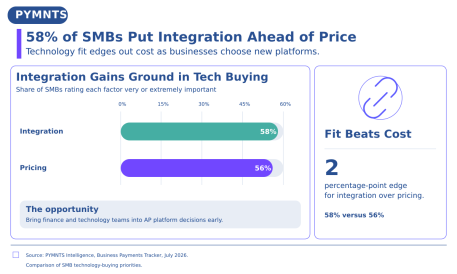
Key findings from the report include integration being regarded as the top factor by 58% of small to medium-sized businesses (SMBs), closely followed by pricing, which was chosen by 56% of respondents. The close competition indicates that compatibility is increasingly viewed as a core business requirement rather than a mere technical issue to address post-selection.
An additional 40% of decision-makers highlighted easy integration as the primary factor influencing their AP automation purchases, alongside easy implementation processes and demonstrated return on investment, which were also named by 37% of respondents. Together, these factors place implementation alongside financial considerations in the purchasing hierarchy.
Despite widespread adoption of AP automation—reported at 89% of organizations—half of the surveyed companies still process more than 5,000 invoices monthly through partially automated workflows. Integration challenges rank as the second most significant concern in automation at 49%, trailing only cost at 50%. Addressing these difficulties could facilitate a transition from fragmented software spending to more comprehensive automation, which in turn could yield substantial benefits.
Notably, 92% of AP professionals believe that automating invoice management and supplier payments would free finance teams to focus on strategic tasks. Additionally, integrated systems are projected to enhance payment accuracy by up to 40%, according to research cited in the report. They also address a key barrier to scaling operations: manual processes and limited automation, which 69% of organizations cite as their primary obstacle—rising to 73% among larger companies.
The report advises integrating technical specialists early in the evaluation process, thoroughly reviewing documentation and testing tools alongside features, and selecting systems capable of adapting as transaction volumes grow. Implementing this strategy can streamline AP operations and ensure they are scalable for future expansion.
Written by urgent.news from PYMNTS's reporting — not their text. Machine-written — may contain errors; check the original before relying on it.