The rise of 'quantum gravity?' Einstein's theory seen in the quantum realm for 1st time
Scientists have spotted the first hints that Einstein's formulation of gravity operates in the quantum realm.
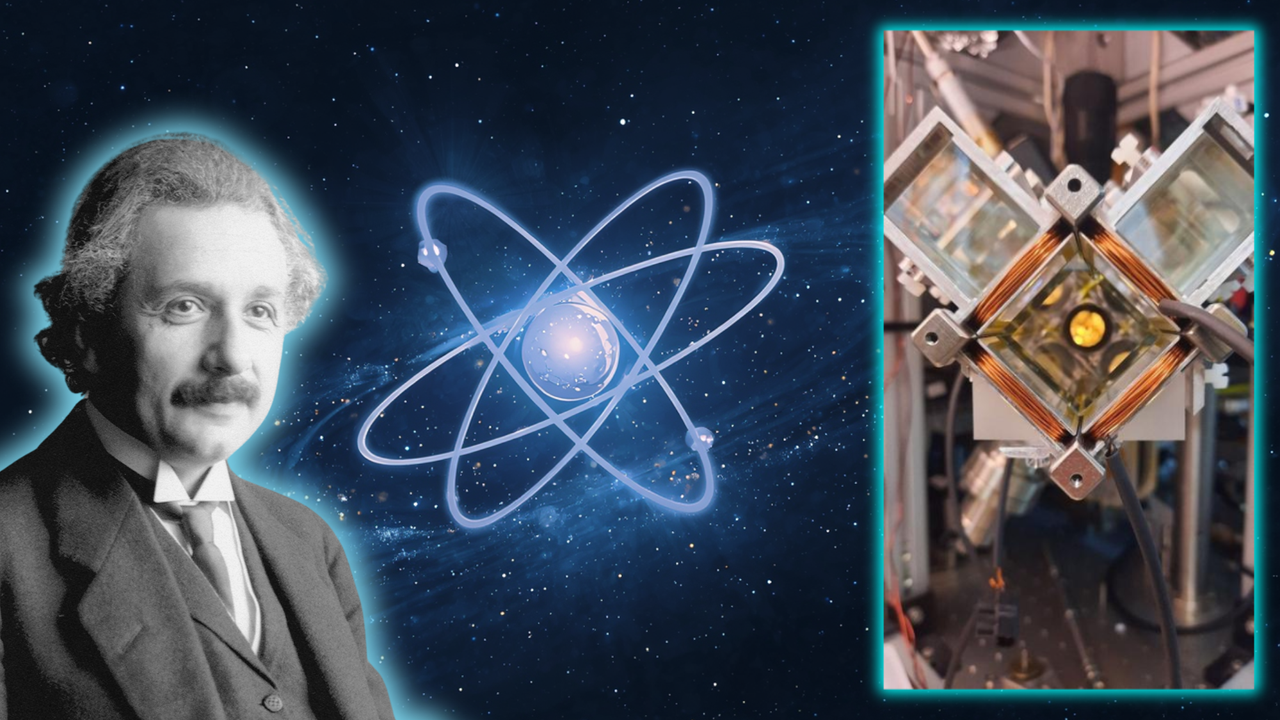
Scientists have detected potential evidence that Albert Einstein's theory of gravity extends into the quantum domain. This discovery involves observations of a falling quantum particle, and although it may appear insignificant (literally, we are discussing atoms), it could represent a significant step towards a "theory of everything."
To understand this, we must first recall the early 20th century, when Einstein's theory of general relativity and quantum mechanics emerged. While general relativity describes the cosmos on scales of planets, stars, and black holes, quantum mechanics governs the counterintuitive physics found in realms smaller than atoms. However, these two fundamental theories do not align well together, and we still lack a quantum theory of gravity.
Nevertheless, scientists believe we are moving closer to unifying these concepts. A team of researchers has conducted an experiment to identify the intersection point between quantum mechanics and general relativity. Specifically, they studied how the quantum properties of atoms change as they fall under the influence of gravity.
This study combines a rigorous experiment with a far-reaching theoretical interpretation, addressing one of the most fundamental questions in physics: how gravity, as described by Einstein's theory of relativity, and quantum theory can be unified into a single understanding of the universe. The experiment's cornerstone is the equivalence principle, a key element of general relativity.
This principle asserts that, for an observer in free fall, gravity should vanish. To illustrate, imagine yourself inside a closed elevator with no view of your surroundings. You feel heavy. If you drop a ball, it will fall to the elevator floor. According to the principle, this could either mean you are stationary on the ground or the elevator is accelerating upwards at the same rate as Earth's gravity (9.8 meters per second squared).
You cannot distinguish between gravity and acceleration. Now, let's alter this scenario. You cannot feel weight anymore; the ball floats as you drop it. Gravity has disappeared, or the upward acceleration has ceased. In the elevator, you cannot determine whether the cable snapped and you are now in free fall, or the upward acceleration has carried you to space and then stopped.
This demonstrates the equivalence principle. The team utilized the Quantum Galileo Interferometer to test this principle at a quantum scale. This equipment split the quantum wave of a traveling atom into two paths: one held stationary while the other fell freely. The team used rubidium atoms cooled to just above absolute zero, placed near the surface of an atom chip.
Microwave pulses placed the atoms in a quantum superposition, allowing them to simultaneously exist in multiple states. Magnetic fields generated by the atomic chip applied an upward push along one path, countering the downward pull of gravity and holding it stationary. The other path experienced magnetic pulses pushing the atoms upwards.
Once the pulses were turned off, the atoms fell freely under gravity, much like a ball thrown upwards. When the waves were reunited, the researchers used interference, a phenomenon where the peaks and troughs of two misaligned waves meet, to measure changes in the free-falling wave. This marked the first time that the effects of gravity and free fall on the phase of a quantum wave had been measured.
Although this experiment demonstrates Einstein's equivalence principle in the quantum realm, it does not constitute proof of quantum gravity. However, it marks a crucial step towards a long-standing goal in physics, which has been pursued for over a century with no resolution. The team's findings were published on September 2 in the journal Science Advances.
Written by urgent.news from Space.com's reporting — not their text. Machine-written — may contain errors; check the original before relying on it.
This story
This is one outlet's version. Read the fullest account.