Urgent.News

What's breaking now, across thousands of outlets.

Business

Nahost: „Ethnische Säuberungen“: Sanktionen gegen Siedler lösen Streit zwischen Großbritannien und Israel aus

Die britische Regierung nennt die Besetzung von Teilen des Westjordanlandes rechtswidrig und kündigt Strafmaßnahmen an. Aus Jerusalem folgt eine scharfe Reaktion.

Nahost: „Ethnische Säuberungen“: Sanktionen gegen Siedler lösen Streit zwischen Großbritannien und Israel aus

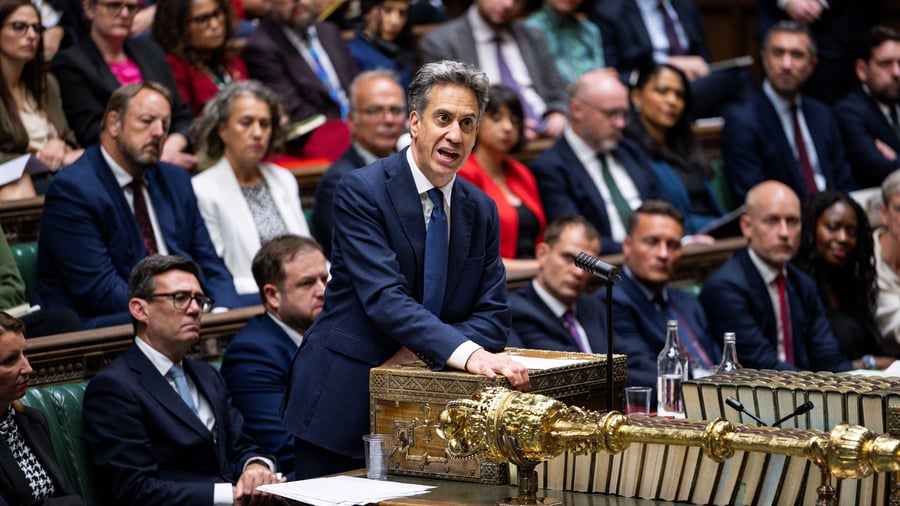
The British government imposed economic sanctions on Israeli settlers in the occupied West Bank on Tuesday. France and Canada joined the punitive measures. Criticism came from the US and Israel in particular. British Foreign Minister Ed Miliband, who is Jewish himself, justified the economic sanctions in the House of Commons. He accused Jewish settlers of committing "ethnic cleansing" of Palestinians in parts of the West Bank: "The British government shares the view that ethnic cleansing of Palestinians committed by terrorist settlers has occurred in parts of the West Bank and that the Israeli government has too often ignored it."

Government members had made statements and taken actions to support the forced displacement of Palestinians. "I announce today that the British government officially considers the occupation illegal," Miliband said, announcing a ban on imports of goods from illegal settlements in the occupied territories. The London government would take further measures against "companies and individuals providing services such as construction, infrastructure, financing or real estate for the expansion of settlements," the Foreign Minister explained.

London also intends to halt all weapons exports to Israel that "substantially contribute to the occupation." Israel announces countermeasures Israel's reaction came immediately. "The accusations made by the Labour government's Foreign Minister in the British Parliament were shameless lies," said Foreign Minister Gideon Sa'ar at a press conference in the afternoon.

With the agreement of Prime Minister Benjamin Netanyahu, Sa'ar announced a series of countermeasures, including the closure of the British consulate in Jerusalem. The British representative was also excluded from the international Gaza support center (IGSC) to implement the US peace plan. The British training program for security forces of the Palestinian Authority in Ramallah would also be terminated.

Twelve Britons, including former Labour leader Jeremy Corbyn and MP Diane Abbott, were banned from entering the country. Sa'ar accused the British government of "systematically working against the state of Israel." He also accused the Labour government of acting for domestic political reasons, as the party conference was taking place at the end of the month.

Former British Prime Minister Keir Starmer had faced significant pressure from the left wing of his party for his pro-Israel stance. The Israeli Foreign Minister claimed that the British government was attempting to influence the outcome of the Israeli parliamentary election on October 27. According to current polls, the government coalition around Netanyahu would lose its majority, which consists of 52 out of 120 seats in the Israeli parliament, the Knesset.

Finance Minister Bezalel Smotrich also commented on the sanctions and called for the expulsion of the British ambassador, who represented a "genocidal government." The ultra-Right Minister for National Security, Itamar Ben Gvir, went even further, calling for the recognition of Argentina's sovereignty over the Falkland Islands and the imposition of sanctions against Britain for its "occupation" of the islands.

Argentina's President Javier Milei retweeted the post. International criticism of Israel grows A joint statement by British Prime Minister Andy Burnham, French President Macron, and Canadian Prime Minister Mark Carney described the coordinated measure against Israeli settlements as a "new turning point in our approach to protecting the two-state solution."

The three state leaders declared that a two-state solution for the Israeli-Palestinian conflict was essential for peace, stability, and security in the Middle East and beyond. They emphasized that it was in the fundamental national interest of Britain, France, and Canada to protect and ensure this outcome. Earlier, the Netherlands, Ireland, Belgium, Spain, and Norway had branded the occupation of Palestinian territories in the West Bank as a violation of international law.

The US, however, did not follow suit: US Secretary of State Marco Rubio made it clear that the US would not join the British initiative. Mike Huckabee, US Ambassador to Israel, even warned of "retaliatory measures" and further "consequences" for Britain, hinting at possible restrictions on the British access to Israel's pharmaceutical sector.

At the heart of the conflict is the E1 project, which would connect Jerusalem with the settlement of Ma'ale Adumim, about ten kilometers to the west. The Israeli government opened tenders for seven residential complexes with over a thousand units in this area in the previous month, after already approving around 3,400 units in August 2025.

Critics, including former US governments, have warned for years that the project would prevent a contiguous Palestinian state by effectively making it impossible. Finance Minister Smotrich, who lives in a settlement, had declared that the E1 project was precisely what was needed to undermine the idea of a Palestinian state.

Written by urgent.news from Handelsblatt's reporting — not their text. Machine-written — may contain errors; check the original before relying on it.

Read the original at handelsblatt.com →

More in Business

More from Tuesday 8 September →