Merchants Put AI to Work Without Handing Over the Customer
The payments and retail industries are asking the wrong question about agentic commerce. The question is not whether an artificial intelligence agent can complete a purchase on its own, because many agents already can. It is whether the merchant wants to let one do so in the first place. Forty-six percent of merchants said pricing […] The post Merchants Put AI to Work Without Handing Over the…

The payments and retail industries are grappling with whether artificial intelligence agents should be allowed to handle the purchasing process independently, rather than whether the AI can carry out the transaction. A survey of 1,185 merchants, 5,241 consumers, and 150 acquirers revealed that 46% of merchants are most unwilling to cede control over pricing and the final cost a customer pays.
Fraud, disputes, and liability were equally concerning, cited by 42% of merchants. Another 41% were unwilling to allow agents to redirect customers to competing merchants. The report suggests that merchants are categorizing AI commerce use cases based on who benefits economically and who bears the risk. This marks a departure from earlier forms of commerce automation.
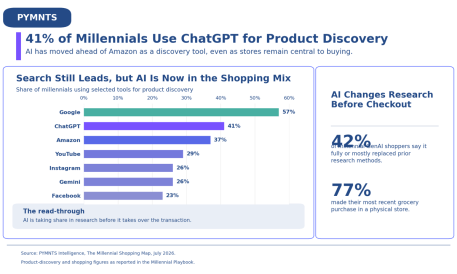
Despite consumers utilizing AI to research their latest purchases (48%), only a quarter of merchants can identify AI-driven traffic and subsequent purchases. Only 15% have structured product data accessible to agents. This discrepancy has prevented merchants from rushing to automate the checkout process. Personalized offers and loyalty programs are among the top investment priorities for merchants, with 31% planning to invest within a year and 62% within two years.
Automated search, rules-based reordering, and customer preference-driven ordering follow closely behind. However, once optimization starts working against the seller, agentic commerce becomes more complex. Agents can become a negotiating layer between the merchant and the customer, potentially finding cheaper sellers, stacking incentives, or switching payment methods.
This is why investment in these capabilities is lower in the near term. Consumers also apply boundaries to AI authority task by task. While 56% are comfortable with agents searching and comparing products, only 35% are willing to give them access to saved payment credentials. The model is not a simple "AI on" or "AI off" switch.
The key to success in agentic retail may lie in companies that develop a system for determining when AI autonomy is economically beneficial and when human approval is necessary.
Written by urgent.news from PYMNTS's reporting — not their text. Machine-written — may contain errors; check the original before relying on it.