Astronomers Have Completed the Largest Map of Space. Yes, You Can Play With It.
The intricate, 5.6 trillion-pixel map covers approximately 75 percent of the sky and includes about 4 billion celestial objects.
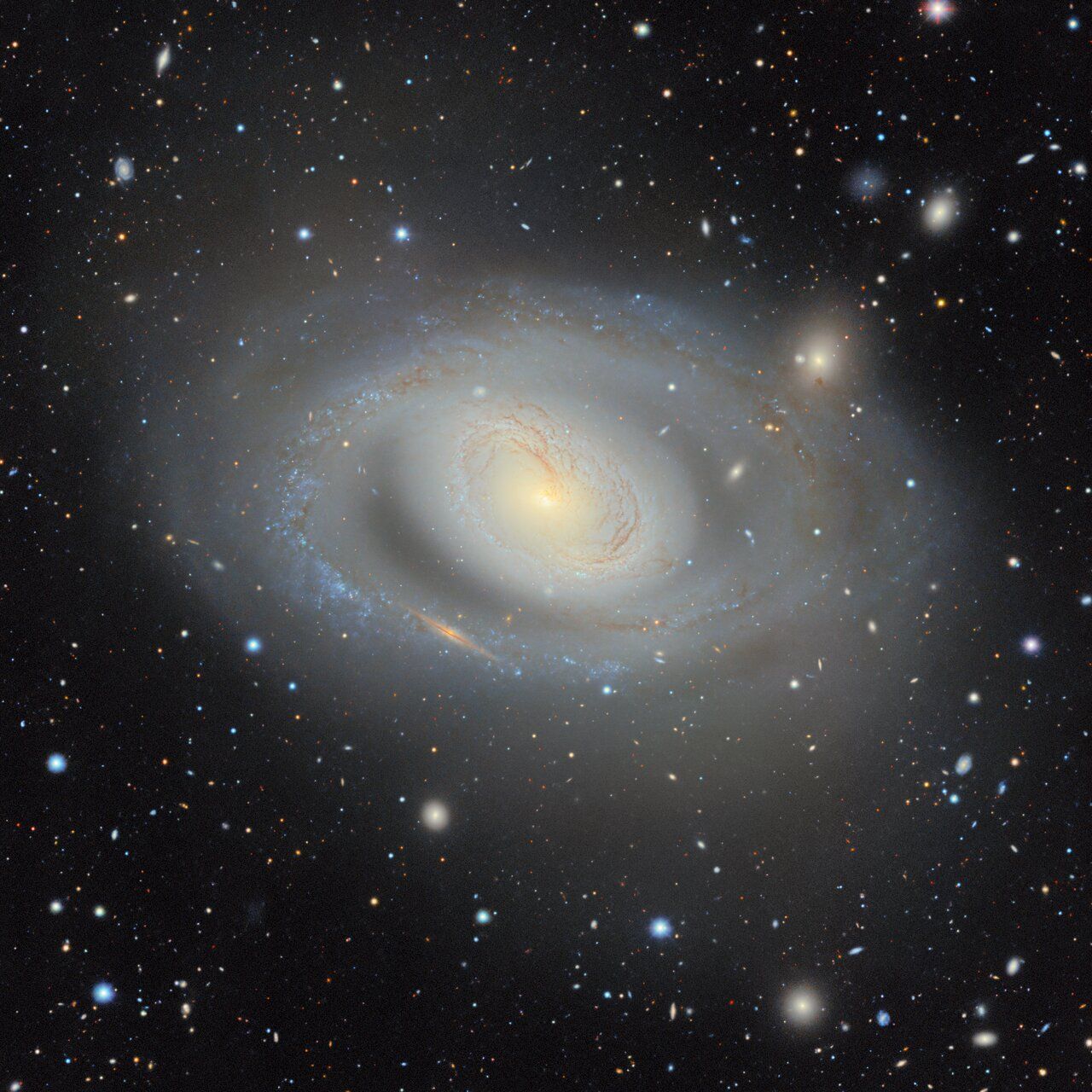
Deep in Arizona's Sonoran Desert rests a remote observatory: the Dark Energy Spectroscopic Instrument (DESI). Over five years, this machine meticulously mapped the cosmos, resulting in the most comprehensive three-dimensional model of the universe ever assembled. Now, with the release of the latest version of the DESI Legacy Imaging Surveys—a freely accessible online platform—space enthusiasts can explore the depths of the universe themselves.
The updated map contains an astounding 5.6 trillion pixels, illustrating roughly 4 billion celestial entities, such as stars, galaxies, black holes, and asteroids. This expansive map spans about three-quarters of the entire sky, capturing both visible light and near-infrared wavelengths. However, the survey's reach is hampered by the Milky Way's interference, which appears as a dense band of stars in the night sky.
To capture clearer images of distant space, researchers pointed DESI's 5,000 mechanical eyes toward either the top or bottom of our galaxy. Although this singular survey took five years to complete, it built upon a prior 13-year foundation. Over 160 scientists contributed to data collection, and since its inception, more than 1,800 scientific papers have cited the data.
"It's become an integral part of astronomy research," remarked David Schlegel, a researcher at the Lawrence Berkeley National Laboratory and co-lead of the Legacy Surveys. "Astronomers today often begin their work by consulting the Legacy Imaging Viewer to familiarize themselves with their subjects." Earlier this year, DESI researchers unveiled another map, depicting the distances of 47 million galaxies and quasars.
This reconstruction spans 11 billion years of cosmic history, illuminating the influence of dark energy. Dark energy is believed to be the driving force behind the universe's expansion; while its nature remains elusive, astronomers track it by observing the speed at which other celestial objects recede from us. The analysis of the first three years of DESI's survey, combined with observations of supernovae and the cosmic microwave background radiation, suggests that dark energy may not be a constant force but is gradually diminishing over time.
The complete five-year dataset is slated for release in 2027, promising astronomers a more detailed picture of the universe's past and present. Moving forward, DESI's observations will serve as a benchmark for other cosmic ventures, such as NASA's recently launched Nancy Grace Roman Space Telescope. Researchers also intend to employ artificial intelligence tools to expedite the analysis of the data, which spans a petabyte scale and still holds many secrets.
"Our universe's exploration often begins with the night sky's imagery," stated Arjun Day, co-director of Legacy Surveys and an astronomer with the National Science Foundation. "These data are crucial to understanding the universe's expansion history and our galaxy's formation. Yet, the skies are for everyone, and this survey offers everyone the opportunity to appreciate its marvels." Originally published on WIRED Japan, this story has been translated from Japanese.
Written by urgent.news from Wired's reporting — not their text. Machine-written — may contain errors; check the original before relying on it.
This story
This is one outlet's version. Read the fullest account.