A US-Russia deal won’t end the war. It will start the next one
Two American processes are converging on the same point: the cost to Russia of attacking NATO. A peace on Moscow's terms lowers the political price; a US troop drawdown lowers the military one. Moscow is waiting to read both before it moves.
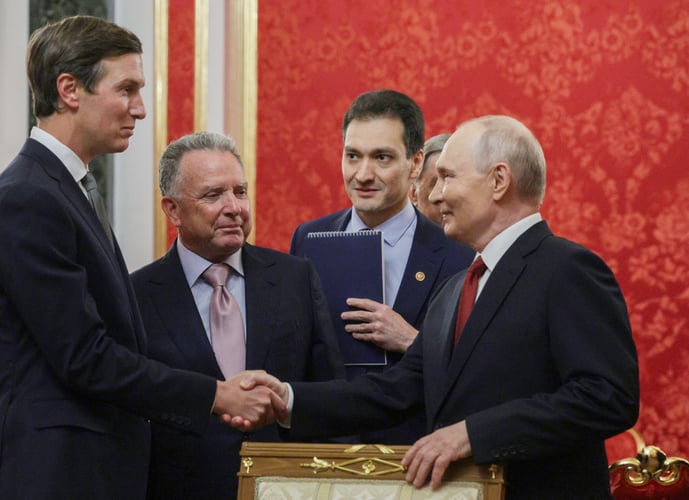
The recent talks between Russia and the United States have been labeled "substantive" by both sides, but analysts are skeptical that any deal reached will end the war in Ukraine. In fact, the opposite may be true. Russian President Vladimir Putin has made it clear that he is only willing to end the conflict on Moscow's own terms, and his demands have become increasingly hardline as he believes the Kremlin now holds a military advantage.
Putin has reportedly stated that he expects to seize the entirety of Donetsk Oblast by the end of 2026. This suggests that any agreement reached at the negotiating table in Moscow will likely be based on Russia's strategic objectives, not a genuine path to peace. The White House acknowledged the talks as "substantive" and "constructive," but it is the underlying political and military processes at play that pose the greater threat.
The situation is complicated further by two parallel American initiatives. First, there is the ongoing effort to negotiate a peace settlement based on Moscow's demands, which the White House describes as "substantive." Meanwhile, there is a separate review process that would gradually reduce the presence of U.S. military forces in Europe. Together, these factors lower the political and military costs of a Russian attack on NATO.
The source material highlights that Russia has a long history of using disinformation to create strategic ambiguity, offering various narratives that all end in the same unpleasant outcome for the West. The first narrative, for example, is a deal that essentially demands Ukraine give up Crimea, Luhansk, Donetsk, Zaporizhzhia, and Kherson.
However, Putin's actual strategic requirements go far beyond these territories, including the demilitarization and "denazification" of Ukraine, as well as ensuring Ukraine's neutrality and excluding NATO from the country.
Additionally, there are more expansive Russian demands such as the term "Novorossiya," which includes Kharkiv, Dnipropetrovsk, Mykolaiv, and Odesa. The most extreme Russian demand is the concept of the "Russian World," which encompasses the former territories of Kyivan Rus, the Kingdom of Muscovy, the Russian Empire, the Soviet Union, and contemporary Russia itself. This ultimate goal of asserting Russia as a Great Power is what the Kremlin sees as an existential threat.
The United States, under President Trump, seems more interested in negotiating a deal that benefits American business interests rather than seeking a genuine peace. This approach neglects international law, security architecture, and the security of its allies. The administration's focus is on trade and might-making-right, which has been evident in statements made by Trump and his aides.
The sequence of events leading up to these talks is also problematic. The US representatives went to Moscow first, carrying Moscow's terms to Kyiv rather than the other way around. An objective team would have consulted European allies first, but the EU's ambassador to Washington, Jovita Neliupšienė, has stated that Moscow's military objectives remain unchanged, implying that US and European strategies are no longer aligned.
In summary, the US-Russia talks are not a sign of a path towards peace, but rather a continuation of a process that could lead to a new conflict. The demands made by Russia are not realistic or achievable, and the United States' priorities appear to be more focused on economic interests than on maintaining a stable European security environment.
The real issue to watch is not the potential deal being negotiated in Moscow, but the broader political and military processes that could enable Russia to achieve its ultimate strategic goals.
Written by urgent.news from Euromaidan Press's reporting — not their text. Machine-written — may contain errors; check the original before relying on it.