Hawaii declares state of emergency as Hurricane Lowell approaches islands
Storm, which may make impact as soon as Monday, is third system in weeks to threaten state during hurricane season Hawaii has declared a state of emergency as powerful Hurricane Lowell makes its way toward the islands, with the first impacts expected as soon as Monday. The storm is the third system in just over three weeks to threaten Hawaii during an active hurricane season in the central…
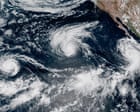
Hawaii has announced a state of emergency in response to the approaching Hurricane Lowell, which threatens to make landfall as early as Monday. This marks the third hurricane to target the islands within a three-week period during an active hurricane season in the central Pacific. At its peak on Sunday morning, Hurricane Lowell maintained category 3 status, with winds reaching 125 miles per hour as it moved northwest at six miles per hour.
Forecasters predict the storm will arrive in Hawaii as a category 2 hurricane, with its center potentially passing between 130 miles west of Ni’ihau and 170 miles west of Kauai between Monday evening and Tuesday morning.
The concerning weather pattern is not isolated to Hawaii, as the Pacific region is currently experiencing a rare occurrence of three hurricanes simultaneously – the first such stretch in a decade. The National Hurricane Center (NHC) is also tracking a fourth potential system off the coast of Mexico, a phenomenon that occurs only eight times per year on average.
While Lowell's offshore path is anticipated to keep the most intense winds away from the Hawaiian islands, heavy rainfall, high surf, and hazardous coastal conditions are still expected. A tropical storm warning has been issued for Kauai and Ni’ihau, where gusts of over 39 miles per hour are possible within the next 48 hours.
The escalating storm activity coincides with the ongoing climate crisis, which experts attribute to the increasing intensity and frequency of storms and other weather events. Two weeks ago, Tropical Storm Moke hit Hawaii's southern islands, bringing heavy rainfall and strong winds, causing at least $43 million in infrastructure damage on the Big Island and $4.6 million in home damage.
The Hawaii governor, Josh Green, emphasized that Lala, the earlier storm, alone inflicted significant damage. This storm surge is occurring as the UN warns that the current El Niño, classified as "supersized" by the organization, is the strongest on record in four decades. The statement highlights that the world finds itself "in the danger zone of extreme weather," with a nearly 100% likelihood that this El Niño will persist through February 2027.
The National Oceanic and Atmospheric Administration (NOAA) has previously warned of a 69% chance that this El Niño will be the strongest in 70 years, further amplifying the chances of extreme weather worldwide.
Written by urgent.news from The Guardian US's reporting — not their text. Machine-written — may contain errors; check the original before relying on it.
This story
This is one outlet's version. Read the fullest account.
- Hurricane Lowell expected to pass near one Hawaiian island and cause major rains statewide apnews.com
- Hurricane Lowell expected to pass near one Hawaiian island and cause major rains statewide toronto.citynews.ca
- Hurricane Lowell expected to impact Hawaii overnight cbsnews.com
- Hawaii residents told to expect tropical storm conditions as Hurricane Lowell passes to the west pbs.org
- Warnings in place as Hurricane Lowell bears down on Hawai'i rnz.co.nz
- Hurricane warning issued for Hawaii as Lowell bears down torontosun.com
- Hurricane Lowell expected to pass near one Hawaiian island and cause major rains statewide winnipegfreepress.com