Enterprise Networks Know Who Connected. AI Agents Make the “Why” Harder
AI agents complicate enterprise trust because identity alone cannot explain intent, delegated authority, or why a connection happened.
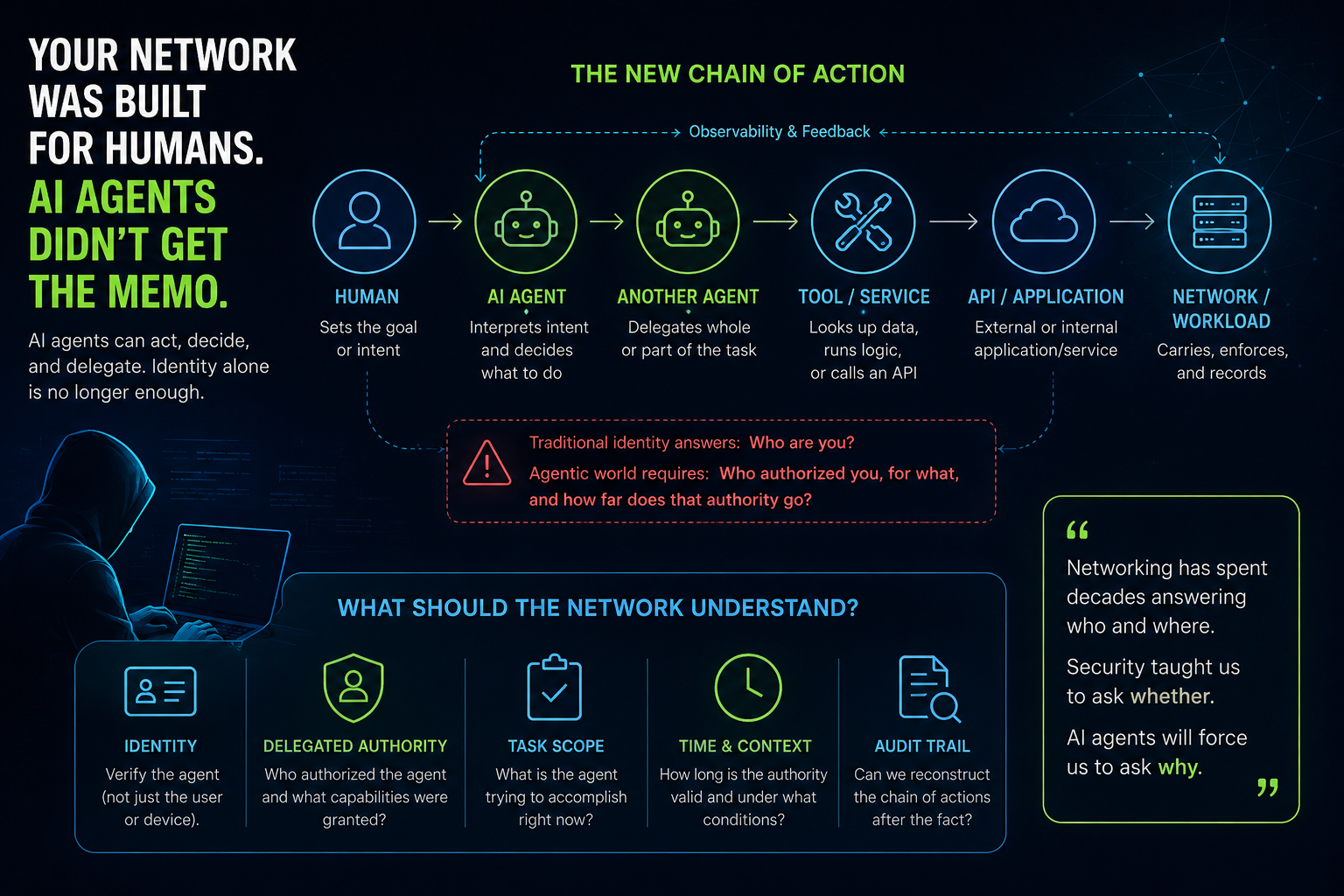
Enterprise networks have long relied on identifying devices, users, and applications to manage access and security. However, the rise of AI agents introduces new complexities that challenge our current approach to network identity. While traditional endpoints have predictable behaviors, AI agents can interpret objectives, access multiple systems, and potentially delegate tasks to other agents, making their actions more opaque.
Consider a scenario where an AI agent assists a user in preparing for a customer meeting. To meet the agent's needs, multiple systems may be accessed, including calendars, email, document repositories, CRM notes, and travel itineraries. The agent may interact with various applications, retrieve information, and call APIs, resulting in numerous transactions.
If someone later asks who accessed a particular resource, determining the correct answer becomes challenging. The agent acted on behalf of the user, and the infrastructure involved in processing the request may not be immediately apparent.
This situation highlights the need for a more nuanced understanding of identity and authority in enterprise networks. While granting an AI agent access to a human's permissions may seem logical, it may not be appropriate in all cases. For example, an agent assisting a user with a specific task may not require access to all related records. Instead, the agent should be granted a narrower form of authority, limited to the necessary information, purpose, and duration.
As AI agents become more prevalent, enterprise networks must adapt to accommodate their unique characteristics. Traditional access control models may not suffice, as they primarily address whether an identity is permitted to access a resource. Agentic systems introduce an additional dimension: determining whether a specific action is appropriate for the task the agent was authorized to perform.
In conclusion, the integration of AI agents into enterprise networks necessitates a reevaluation of how we define and manage network identity. We must move beyond a simple association between an identity and access rights, considering the potential consequences and nuances of agentic actions. By adopting a more precise approach to identity and authority, we can ensure that AI agents operate within appropriate boundaries while maintaining the security and efficiency of enterprise networks.
Written by urgent.news from HackerNoon's reporting — not their text. Machine-written — may contain errors; check the original before relying on it.