Plea to give Thames seals space for everyone's safety
Getting too close to the animals spotted along the River Thames can be harmful for both them and members of the public, a charity says.
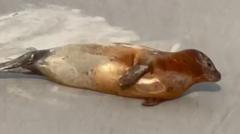
Marmalade, the golden harbour seal, was a familiar sight in the River Thames, often seen at Greenwich and Rotherhithe in southeast London. Her nickname came from her bright coat. However, with more seal sightings along the river, Thames Seal Watch, a charity, has urged the public to give seals space. Emma Kelly, from the charity, explained, "They can bite and carry zoonotic diseases, which are unpleasant if you're bitten.
They do it to protect themselves." Getting too close to the animals can cause them distress, potentially leading to their death.
The number of seals in the Thames has increased, with about 3,500 living there, mostly around the estuary east of London. Marmalade was considered rare, with only 500 harbour seals in the river. Gareth Richards from UK Seal Alliance noted that seals are "very transient," moving to where fish stocks are abundant. They can swim up to 60-80 miles a day.
Richards advocates for further legal protection for seals in law. Neither grey nor harbour seals are protected under the Wildlife and Countryside Act 1981 from intentional or reckless disturbance. In May, UK Seal Alliance launched its "Give Seals Space" campaign, urging the government to provide legal protection to the two species. Disturbance from the public, animals, and drones can have long-lasting health consequences for seals and may lead to pup abandonment, wasted energy, and injuries from fleeing.
UK Defra states that there are legislative protections in place, making it an offence to take, injure, capture, or kill a seal. Marmalade contracted a parasite disease and passed away in May. Volunteers from Thames Seal Watch, including Emma Kelly, gathered near her favorite spot near the University of Greenwich for a memorial. They threw flowers into the river and erected a plaque in her memory.
Kelly said, "Marmalade was really special to the community. We created a community around Marmalade where there was lots of us to keep an eye on her and ensure she stayed safe. Marmalade also helped attract new volunteers to the charity, and all at the memorial committed to continuing to help London's wildlife."
Written by urgent.news from BBC Science's reporting — not their text. Machine-written — may contain errors; check the original before relying on it.