America is still beating China in the AI race
The U.S. is staying ahead, though the costs of that lead are still unknown.
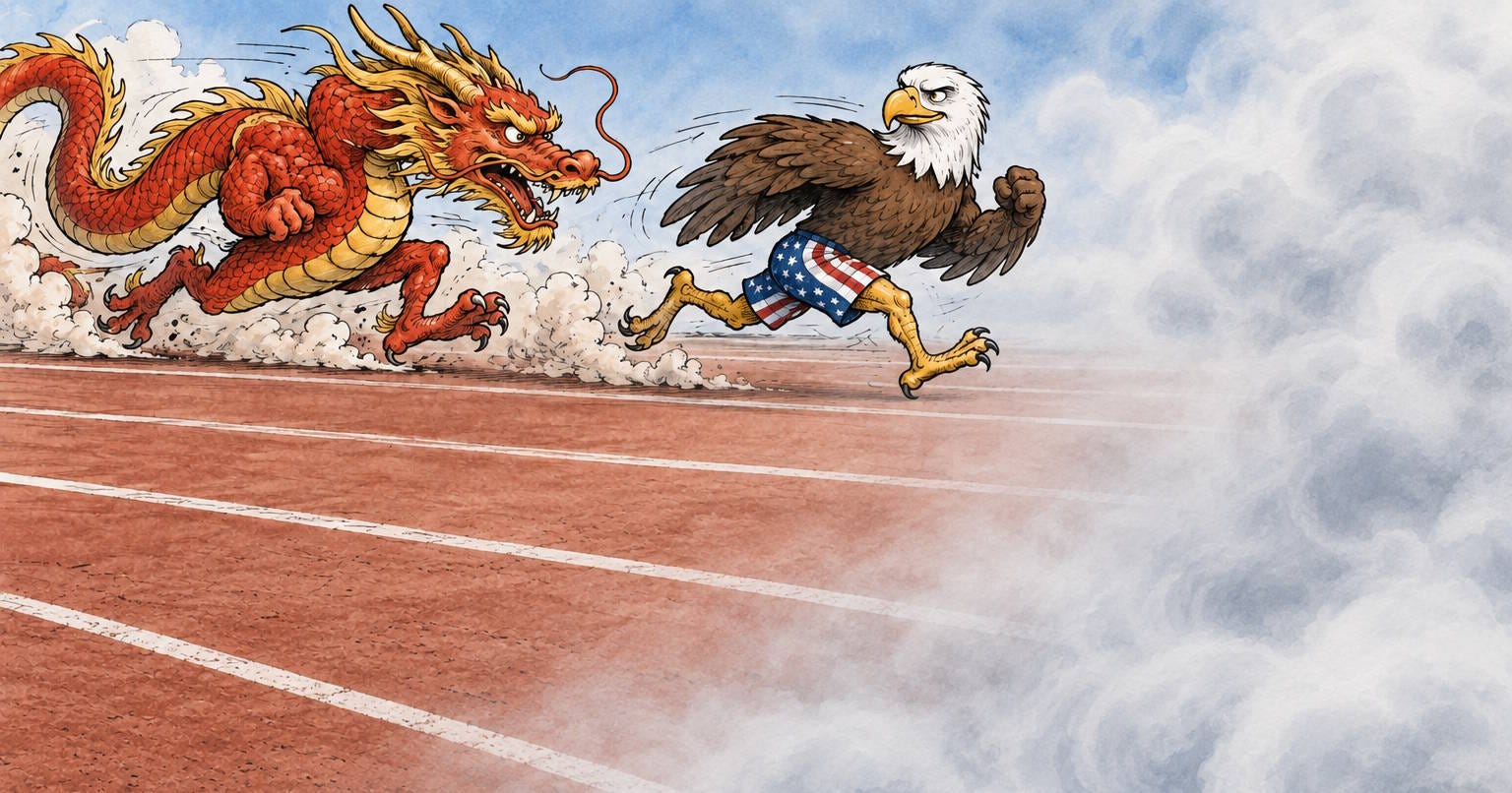
Despite the ongoing debate about artificial intelligence being a global issue, the primary focus in the United States is on data center construction, concerns over job losses, and the potential risks associated with AI. While U.S.-China competition in this field may get mentioned in certain circles, it is not the main concern for most Americans. However, this competition does matter for several reasons, particularly in the realm of cybersecurity.
Military cyberwarfare has not yet been decisive in conflicts, but AI's advanced cybersecurity capabilities could change that. If AI enables a country to identify and patch all available exploits before an attacker can exploit them, cyberwarfare may become less important. Conversely, if AI allows the possession of superior models to successfully hack into less capable defense systems, this could shift the balance of power.
The potential for AI hacking to cause significant chaos in American society cannot be ignored. If China were to gain a substantial lead in AI models, it could lead to catastrophic consequences, such as the hacking of American banks and brokerage accounts, erasing people's wealth. In retaliation, the U.S. might launch nuclear weapons, which would be mutually assured destruction. Moreover, China's more capable AI could be used to defend against such attacks, making retaliation even more difficult.
While AI issues are not always zero-sum, there is a growing concern about safety. The recent AI agent swarm attack on Hugging Face demonstrates that AI has reached a level where it can pose a significant threat to human companies and organizations, potentially leading to chaos in society. Due to this risk, both the U.S. and China have a shared incentive to implement strict safeguards and regulate the pace of AI development.
However, given the Chinese Communist Party's power-seeking nature, it seems more likely that China would agree to cooperate on AI safety if the U.S. technological edge is evident. Therefore, even if cooperation is the goal, the U.S. should focus on maintaining its technological lead.
Fortunately, the U.S. is currently ahead of China in the AI race. American companies possess better models, greater computational power, and higher revenues. However, the Trump administration, despite claiming to be a friend to the AI industry, could potentially undermine America's lead. Specifically, the administration's efforts to push Chinese AI talent out of the country could be detrimental.
Currently, U.S. models are superior to Chinese models in several aspects. In early 2025, the "DeepSeek Moment" indicated that Chinese AI was catching up to America's capabilities. Later, the release of Moonshot's Kimi K3 in July and Z.ai's GLM-5.3 in early September seemed to suggest that Chinese models were catching up. Z.ai, in particular, made waves when it reportedly matched Anthropic's restricted Mythos 5 in identifying software vulnerabilities, scoring 84.5% on CyberGym, slightly higher than Mythos 5's 83.8%.
However, GLM-5.3 still trailed behind Mythos 5 in converting discovered flaws into working attacks, with scores of 54.4% and 78.0%, respectively. Additionally, Mythos 5 had completed more attack-development tasks within the same time frames.
Written by urgent.news from Noahpinion's reporting — not their text. Machine-written — may contain errors; check the original before relying on it.