UN votes to adopt new world map to reflect Africa's true size
The Togo-sponsored resolution was backed by 164 nations - the US the only nation to vote against it.
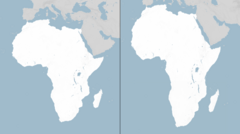
The United Nations General Assembly has decided to replace the traditional world map with a new one that better represents the true size of Africa. The "Correct the Map" resolution, proposed by Togo and supported by African Union (AU) nations, received backing from 164 countries, including France and the United Kingdom. Only the United States voted against the resolution, with six nations abstaining.
The widely used Mercator map, in use since the 16th century, has been criticized for depicting Africa as being roughly the same size as Greenland, despite Africa being 14 times larger. This map distortion has led to the underestimation of the development potential and needs of equatorial countries. The Mercator map, designed by Flemish cartographer Gerardus Mercator in 1569, was created to aid European explorers in navigation.
The distortion is a consequence of the challenge of representing a spherical Earth on a two-dimensional surface. In 2018, a team of cartographers developed an equal area map called the Equal Earth projection to address this issue. The African Union's 54 member states adopted the Equal Earth projection in February, emphasizing its ability to more accurately depict the sizes of all continents, particularly Africa.
Togolese Foreign Minister Robert Dussey emphasized the importance of accurate maps during the UN briefing, stating, "A fair world begins with a fair map." The UN vote, while non-binding, will prompt changes to the maps utilized by various institutions worldwide.
Written by urgent.news from BBC World's reporting — not their text. Machine-written — may contain errors; check the original before relying on it.
This story
This is one outlet's version. Read the fullest account.
- US opposes UN adoption of map showing Africa’s true size thenationalnews.com
- UN ditches Mercator map to adopt more accurate one reflecting Africa's true size france24.com
- UN backs African-led push for world maps that show Africa’s size more accurately peopledaily.digital
- UN approves resolution in support of map that shows Africa’s true size myjoyonline.com
- UN adopts proposal for new world map showing Africa’s true size punchng.com
- UN votes to adopt new world map that shows true size of Africa premiumtimesng.com
- France drops Mercator maps as Africa pushes for truer world view rfi.fr
- UN votes to adopt new world map that reflects Africa’s true size aljazeera.com