The Economic Costs of Solar Storms
Though less present in the public consciousness than hurricanes and wildfires, space weather represents a real and potentially significant threat to society.
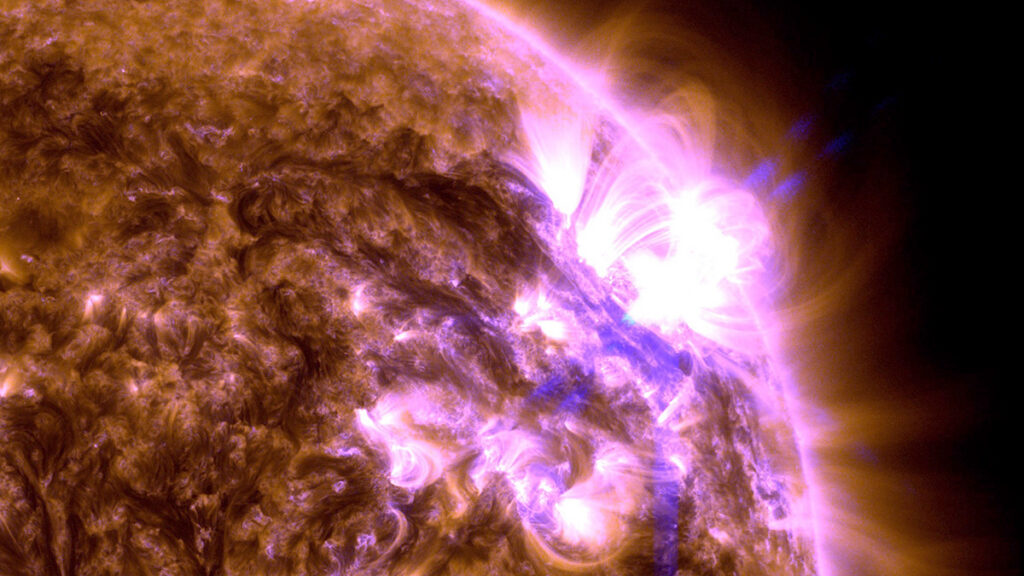
In 1967, a solar storm came close to sparking global conflict by disrupting early-warning radar systems in the United States, leading authorities to suspect the Soviet Union. However, thanks to accurate forecasts from solar experts, a major war was avoided. Yet, the threat from space weather, specifically solar or geomagnetic storms, remains a concern.
These storms arise when the Sun ejects plasma and magnetic fields during coronal mass ejections. As they travel through space and interact with Earth's magnetic field, they can interact with conductive materials and create geoelectric fields. The resulting currents can destabilize electrical transmission by flowing over high-voltage transformers within the power grid.
Although the potential for destruction from geomagnetic storms is significant, their economic impact has been poorly quantified. A recent study by Oughton et al. developed a new framework to estimate the financial consequences of a once-in-250-year geomagnetic storm in the United States. By integrating physics, engineering, and economics, the model characterizes hazards, assesses grid vulnerabilities, and predicts socioeconomic consequences depending on the storm's intensity.
When validating the model, researchers compared simulated impacts on electric substations to measurements taken by the Tennessee Valley Authority during the 2024 Gannon storm. Under a 100-year geomagnetic storm, approximately 3.5 million individuals and 91,000 businesses could lose power, resulting in daily economic losses of $1.22 billion.
A more severe 250-year storm, the most intense scenario examined, would impact up to 5 million Americans and over 135,000 businesses. Such an extreme event would cause direct losses of around $980 million daily and total economic losses of $1.81 billion per day.
The study provides a thorough evaluation of the socioeconomic risks posed by space weather and suggests areas for investment in the power grid to enhance resilience against future storms. The authors also point out that future research should explore the cascading effects on the power grid and how multiple hazards, like a geomagnetic storm coinciding with a heat wave or hurricane, could further exacerbate the situation.
Written by urgent.news from Eos's reporting — not their text. Machine-written — may contain errors; check the original before relying on it.