Run-Clubs: Erst Run Club, dann Cappuccino – ein neues Geschäftsmodell für den Laufsport
Vom Individualsport zur Gemeinschaftsaktivität: Run-Clubs verändern den Laufsport. Davon profitieren viele Sportmarken. Und die Konkurrenz wächst.
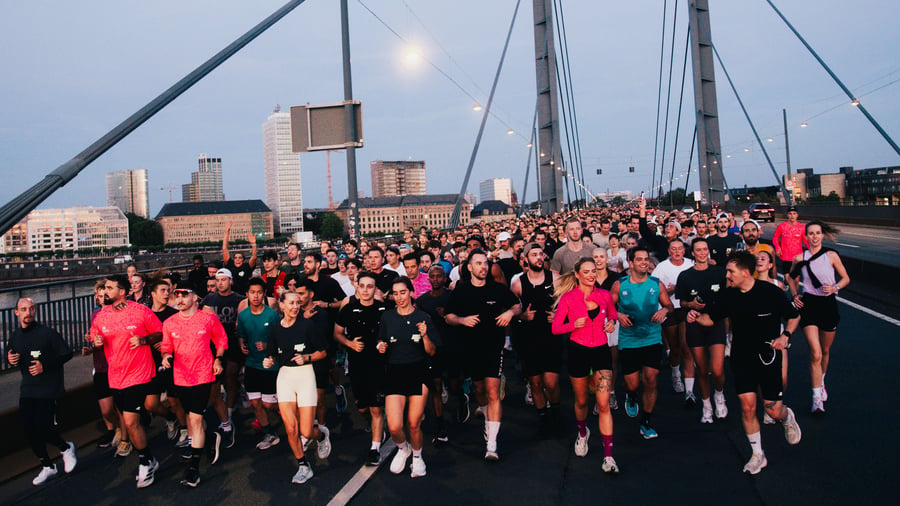
At around eight o'clock on a Sunday morning in Düsseldorf's Old Town, people from various directions converge on the square in front of a church on Bastionstraße wearing running clothes. Every week, more than a hundred runners gather there for a warm-up and a five to ten kilometer run. David Ebisch, one of the founders of the sport brand Another Cotton Lab, greets the group at the start of the run.
Since two years, the running group meets weekly, with some regulars and occasional attendees. Participation is free and voluntary, with participants often wearing the brand's clothing, but it is not mandatory. Ebisch believes the run club was a natural step: "We were running together once a week anyway. So we thought, why not invite our friends and customers to join us?"
At first, only a handful showed up, but special events sometimes attracted 200 to 300 runners. Typically, around 100 participate. For Another Cotton Lab, the format has become a growth vehicle. Traditional brands also want to benefit from the popularity of run clubs. The running sport is one of the few growing segments in the sports market.
As competition for run club formats increases, the question arises: Who can economically benefit from this trend? Run clubs are becoming more popular, especially in Düsseldorf, where numerous run clubs exist. Most have a commercial background, such as Absolute Run, a specialized concept brand of the retailer group Sport 2000. About 100 retail stores under the Absolute Run and Running Experts names operated by Sport 2000 in Germany offer running club meetings.
Marc Scheiner, who leads the Running department at the retailer association, says, "For a running specialist, the offer of community runs is an absolute must today." Product tests at such meetings often lead to subsequent purchases at local specialty stores. Run clubs are also often connected to loyalty programs for regular participants.
Look also: These sports trends on Instagram and TikTok should be known. The interest in such events is clearly growing. Even large sports apparel manufacturers like Adidas notice this. In the past two years, they have seen a significant increase in interest and members. Adidas and Nike have been offering such formats for years, often with the opportunity to test products from their brand on-site.
Adidas has run 50 groups in more than 40 countries for ten years, including five in Germany. The runs start from Adidas stores and range from relaxed beginner tempos to interval training. Run clubs allow participants to learn more about products and provide valuable insights into the needs and expectations of the running community.
Adidas wants to present itself as a brand with running expertise and thus bind customers more closely. Ebisch, a co-founder of Another Cotton Lab, acknowledges that the run club was not introduced as a marketing measure, but the company has benefited greatly from it. "With the run club, we can express the values behind the brand," he says.
Maximilian Marten, a consultant for sports, fashion, and luxury companies, confirms that it is easier to convey emotions associated with the brand and its clothing products through a run club than through technical expertise, such as that provided by advanced running shoes. Community management and market research are key levers for customer acquisition and retention through run clubs.
Running, which was long considered an individual sport, now has a social aspect that is at least as important to many participants as the sport itself, according to surveys such as the YouGov study commissioned by running shoe manufacturer Brooks. Brooks also offers its own run clubs. In the survey, over 1200 runners aged 18 to 36 in eight European countries were asked, all of whom had participated in a run club.
Brooks offers its own run clubs as well. So, for participants, the performance aspect is secondary, with social contacts being more important. 91% reported forming new friendships through a run club. In addition to running clubs, club sports fill this gap in the offer, according to Sebastian Uhrich, a professor of sports business management at the Cologne University of Applied Sciences.
Run clubs have lower entry barriers and focus even more on the social aspects of the sport. They primarily address the "urban, modern sports enthusiast." Even if they advocate commercial interests, they can benefit from this strategy. Another Cotton Club, for example, generated a million euros in revenue in the founding year of 2023 and more than ten million in 2025.
The start-up also became viral on social media with its "Sunday Running Club" concept. Participants feel connected to the brand's club. Running clubs also allow for exchanging new products and product wishes with the founders, which is a decisive advantage for small brands, according to Marten. "If done correctly, run clubs can be a fantastic market research tool."
The feedback expressed there can have a real impact on the company's products, especially for small brands.
Written by urgent.news from Handelsblatt's reporting — not their text. Machine-written — may contain errors; check the original before relying on it.