Korea Heritage Service sets up temporary shelter to restore Egypt's Ramesseum temple gate
The Korea Heritage Service (KHS) and its affiliate, the Korea National University of Heritage (KNUH), held a completion ceremony Wednesday for a temporary protective shelter built over the Ramesseum temple's pylon gate in Luxor, Egypt, marking a milestone in a Korean-led restoration project. The Ramesseum is the mortuary temple of Pharaoh Ramesses II, who ruled Egypt's 19th dynasty from roughly…
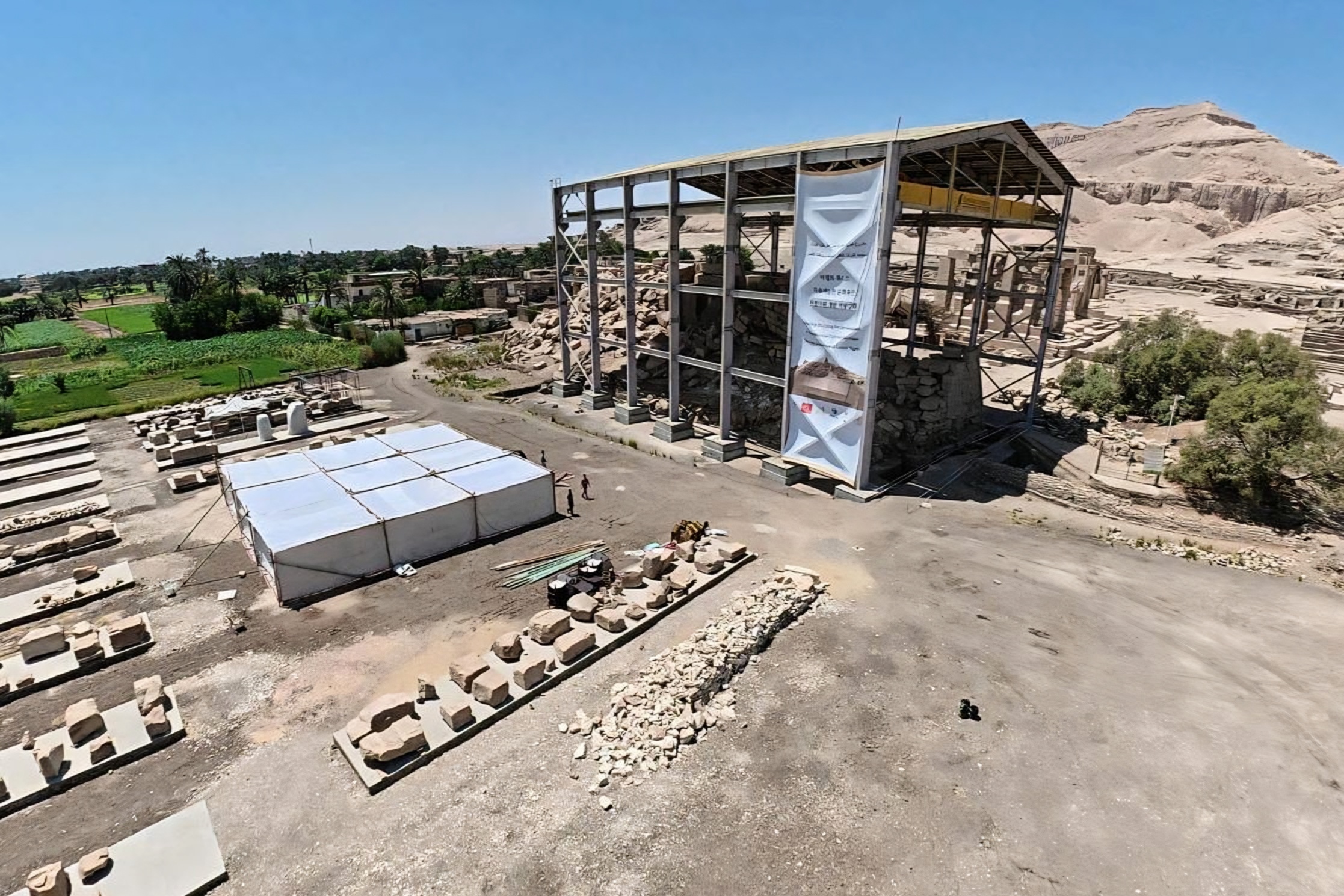
The Korea Heritage Service (KHS) and its partner, the Korea National University of Heritage (KNUH), unveiled a temporary shelter over the Ramesseum temple's pylon gate in Luxor, Egypt on Wednesday. This marks a significant achievement in a Korean-led restoration initiative. The Ramesseum serves as the mortuary temple of Pharaoh Ramesses II, who reigned over Egypt's 19th dynasty roughly between 1279 B.C. and 1213 B.C.
It is an integral part of the UNESCO World Heritage site, Ancient Thebes and its Necropolis. The structure has been vulnerable to deterioration due to weather conditions, extreme temperature fluctuations and earthquake risks. The Korea Heritage Service (KHS) and KNUH have been collaborating with Egypt's Supreme Council of Antiquities (SCA) under the leadership of Secretary-General Hisham El-Leithy since 2023 on a five-year project to dismantle and restore the temple's pylon, or the monumental gateway.
During the excavation and survey operations, researchers identified a cartouche, a symbol of a pharaoh's name in hieroglyphs, belonging to Ramesses II along with an as-yet unrecorded place name which could potentially confirm the scope of his empire's reach.
Written by urgent.news from The Korea Times's reporting — not their text. Machine-written — may contain errors; check the original before relying on it.
This story
This is one outlet's version. Read the fullest account.