Cats and mind-full mechanics: what happens when quantum physics meets the brain
Cats are wonderful gymnasts. Their ability to land on their feet – even when dropped upside-down – caught the attention of two of the nineteenth century’s greatest mathematical physicists, Sir George Gabriel Stokes and James Clerk Maxwell. The remarkable feats of cats inspired these theorists to perform, in the 1850s, legendary experiments in “cat-turning”, as Maxwell later described: “There is a…
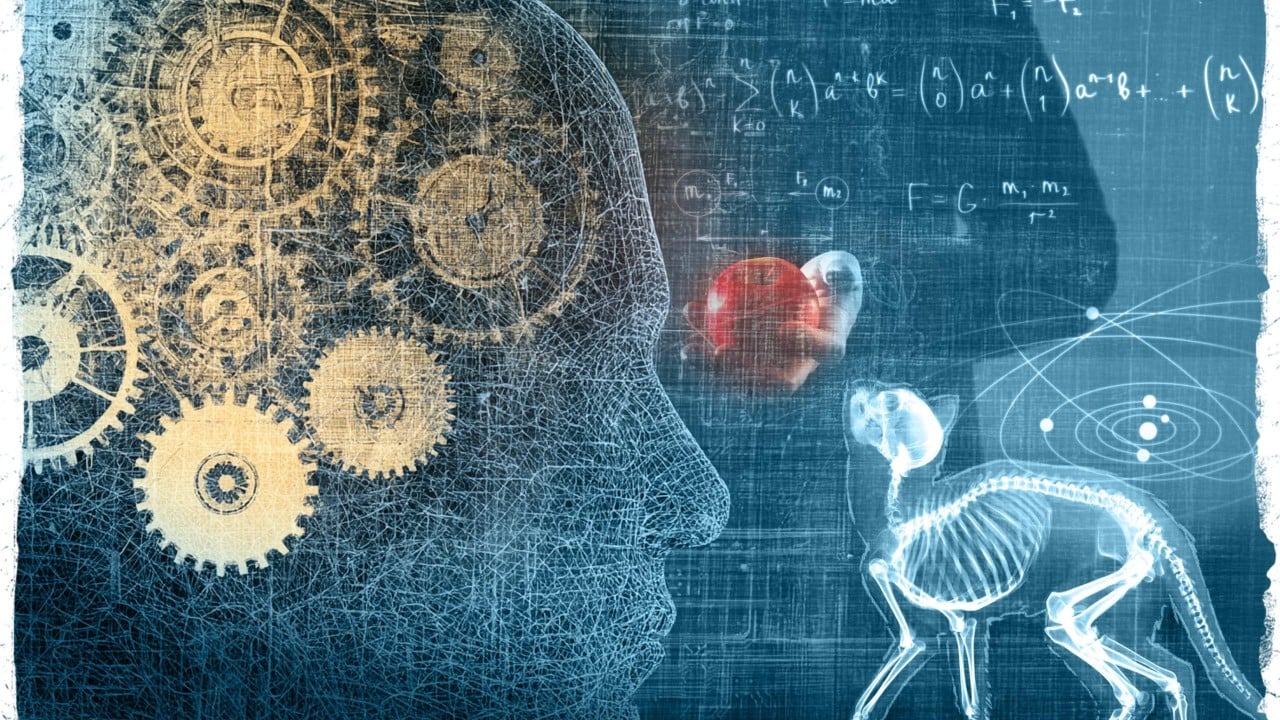
In the 1850s, renowned physicists Sir George Gabriel Stokes and James Clerk Maxwell were fascinated by cats' extraordinary ability to land on their feet. This led them to conduct legendary experiments known as "cat-turning," which aimed to understand the mechanisms behind the cat's rapid reorientation. However, these experiments were constrained by the technology of the time.
The development of high-speed photography by Etienne-Jules Marey in 1894 provided a breakthrough in the field, as it allowed for the recording of 12 frames per second, capturing the intricate steps cats took to land on their feet. In 1969, a classic dynamical model emerged, which only recently began replacing idealized models with accurate representations of a cat's spine.
Similarly, human divers and gymnasts learn to control their bodies through reorientation, demonstrating similar reflexive abilities. The tension between Newtonian mechanics and the seemingly mind-driven actions of cats, divers, and gymnasts has been a topic of interest since Stokes and Maxwell's time. One reason for this fascination lies in the relationship between angular momentum and angular motion.
By executing a closed loop in its space of possible shapes, the cat manages to rotate despite having zero angular momentum and no external torque. This phenomenon would be impossible for a rigid body under Newtonian mechanics. The concept of "mind-full mechanics" is introduced to address this gap. It encompasses the integration of ideas about will, control, and goal-seeking behavior into classical mechanics.
Classical Newtonian mechanics governs how willed shape changes translate into motion through space, while "will" is the product of minds that have plans, monitor progress, and respond to external cues. By acknowledging the role of "will" and "mind" in mechanics, we can better understand the complex behaviors observed in cats, divers, and gymnasts.
This expanded approach, known as "mind-full mechanics," draws from fields such as biomechanics, control theory, and robotics. In essence, it recognizes that purpose is not a new force but a new way of organizing forces within the framework of classical mechanics.
Written by urgent.news from Reuters Business via SCMP's reporting — not their text. Machine-written — may contain errors; check the original before relying on it.
This story
This is one outlet's version. Read the fullest account.