Cats and mind-full mechanics: what happens when quantum physics meets the brain
Cats are wonderful gymnasts. Their ability to land on their feet – even when dropped upside-down – caught the attention of two of the nineteenth century’s greatest mathematical physicists, Sir George Gabriel Stokes and James Clerk Maxwell. The remarkable feats of cats inspired these theorists to perform, in the 1850s, legendary experiments in “cat-turning”, as Maxwell later described: “There is a…
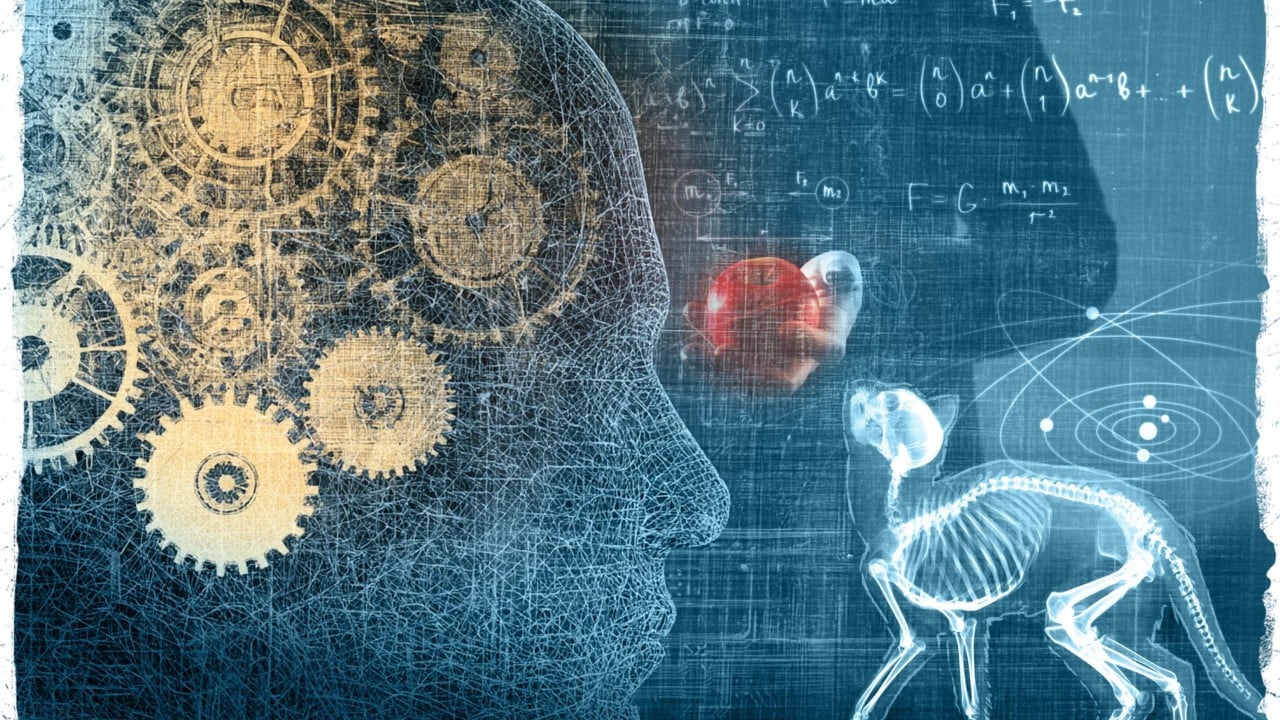
Cats showcase remarkable agility, landing on their feet even when dropped upside-down. This talent intrigued two 19th-century physicists, Sir George Gabriel Stokes and James Clerk Maxwell, who conducted experiments around "cat-turning." Maxwell himself admitted to having thrown cats out of windows to demonstrate the feat. However, the experiments were limited by the technology available at the time.
A major breakthrough came in 1894 when Etienne-Jules Marey introduced high-speed photography, capturing a series of stop-action photos that illustrated the sequence of actions cats use to reorient themselves mid-air.
In the 1960s, a groundbreaking dynamical model emerged, which continues to evolve. Modern studies now incorporate real data regarding a cat’s spine rather than relying on idealized models. Humans who engage in diving or gymnastics also exhibit cat-like abilities in controlling their bodies during motion. This control may be primarily reflexive in cats but planned, rehearsed, and revised in humans.
The tension between Newtonian mechanics and the cat's movements stems from the apparent violation of Newtonian principles. Newtonian mechanics posits that acceleration and motion are driven by physical forces rather than willpower. The cat's ability to change orientation without external torque seems impossible for a rigid body. This conundrum arises due to the cat's ability to traverse a closed loop in its shape space, thereby achieving rotation.
Classical Newtonian mechanics requires cognitive dissonance, as it demands reconciling the everyday notion of will and purpose with its austere, mathematical framework. Before the rise of the mechanical worldview, self-directed motion was often attributed to an animating principle, or a soul, separate from inert matter. Today, we understand that matter, governed by simple mathematical laws, can exhibit complex emergent behavior seen in molecular biochemistry, neurobiology, and artificial intelligence.
This understanding enables us to integrate the concept of mind into mechanics, leading to the development of "mind-full mechanics."
Written by urgent.news from South China Morning Post's reporting — not their text. Machine-written — may contain errors; check the original before relying on it.