When failure is rewarded: The troubling state of South Africa’s state-owned enterprises
The disconnect between glossy reports and the everyday struggles of citizens poses an urgent challenge for South Africa's state-owned enterprises. As the country faces the realities of failing systems, the call for accountability has never been more pressing. Will anyone step up to meet this moment?
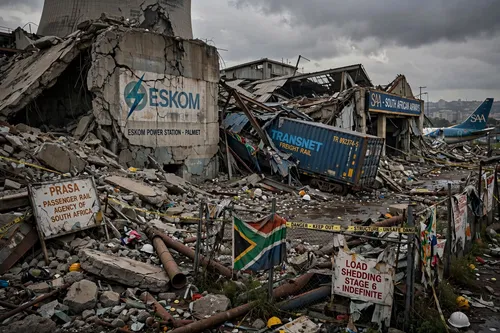
The state of South Africa's state-owned enterprises is a troubling one, as politicians applaud annual reports while ordinary citizens endure the consequences of their failure. On one hand, glossy reports showcase smiling executives, colorful graphs, and words like resilience and sustainability. On the other hand, pensioners wait weeks for electricity, commuters are stranded, municipalities cannot supply water, and ports stand idle.
The question is not why these enterprises are failing, but why so many continue to benefit from that failure.
State-owned enterprises were originally intended to serve the public, not as investment vehicles for political networks. Eskom was supposed to electrify the nation, Transnet to move the economy, Denel to strengthen strategic capability, PRASA to transport workers, the South African Post Office to connect communities, and SAA to represent the country abroad. However, many of these enterprises now appear focused on protecting their managers rather than serving the public.
The financial burden of these failures is immense. Eskom's debt exceeds R400 billion, taxpayers have transferred billions to keep the lights on, Transnet's operational failures cost the economy hundreds of billions through delayed exports and congested ports, and the South African Post Office entered business rescue after years of losses, leaving thousands of employees without a livelihood. South African Airways survived only after repeated government bailouts, only to emerge as a much smaller airline.
Executives continue to receive astonishing bonuses and retention incentives, despite constant performance declines and auditor concerns. The media reports scandals, but executive remuneration remains resilient. One wonders if failure has become the safest career path in South African public administration.
Within these organizations, whistleblowers often face intimidation, disciplinary action, and career destruction. Repeated allegations highlight shady contracts, rushed procurement processes, and collapsing projects. When whistleblowers speak out, investigations typically focus on identifying the disruptor rather than discovering facts. The whistleblower becomes the problem, while the accused becomes the victim.
The focus shifts from what happened to who exposed it, turning the institution's attention to culture, trust, alignment, and professional conduct. Corporate language disguises institutional decay with phrases like transformation, strategic repositioning, and business optimization. Annual reports often describe intentions rather than outcomes, creating a disconnect between the public's experiences and the reported successes.
South Africa has seen millions of rand spent defending labor disputes that should never have existed, with executives continuing uninterrupted. The greatest irony is that South Africa possesses no shortage of policies, yet public money is consumed through legal battles, disciplinary hearings, settlements, and wrongful dismissals.
The executives responsible often continue uninterrupted, while the taxpayer funds both sides of the disputes. Yet the human cost remains unreported, with marriages destroyed, depression hidden behind professional smiles, and children watching parents leave home without work. The reputation of these institutions rarely fully recovers, and wrongful dismissals consume enormous public resources.
Written by urgent.news from IOL's reporting — not their text. Machine-written — may contain errors; check the original before relying on it.
This story
This is one outlet's version. Read the fullest account.
- Low jet flyover of Cape Town stadium sparks South Africa safety probe scmp.com
- South Africa aviation regulator probes low jet flypast over Cape Town stadium apnews.com
- Cape Town proposes grave reuse and stricter rules for funeral undertakers iol.co.za
- South African airline behind daring stadium stunt cancels next flyby myjoyonline.com
- South Africa aviation regulator probes low jet flypast over Cape Town stadium abcnews.com
- Low flypast over Cape Town stadium to be reviewed, South Africa says cbc.ca
- Search continues for two men missing in Cape Town’s Strand beach sabcnews.com
- South African airline behind daring stadium stunt cancels next flyby, regulator says bbc.co.uk