Webb Space Telescope photographs weird galaxy that not only looks “unusual,” but behaves oddly too
Astronomers think that Arp 263, an “irregular” galaxy located 25 million light-years from Earth, is the result of a past galactic merger, responsible for its “distorted” shape
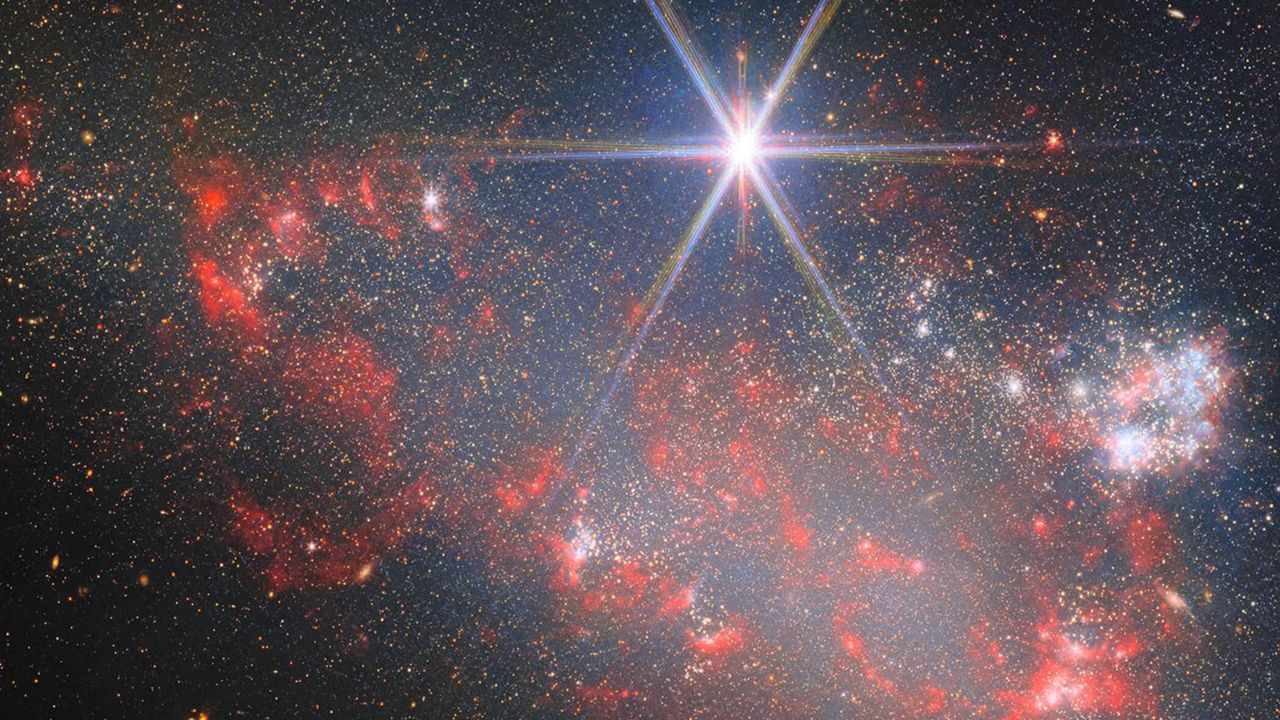
Since its launch in 2021, the James Webb Space Telescope has captured numerous stellar spectacles, but it seems to be observing the unusual as well. Astronomers from the European Space Agency, in collaboration with NASA, have published a photograph captured by the telescope showcasing a galaxy known as NGC 3239, also recognized as Arp 263.
The galaxy's peculiar, distorted shape and the orientation of its stars in relation to its hydrogen gas led the astronomers to describe it as "unusual." Classified as an "irregular" galaxy, Arp 263 is the result of a cosmic merger between two separate galaxies, which explains its irregularity. It is believed that the other galaxy involved in the merger, now no longer visible, was likely a dwarf galaxy that was entirely assimilated into the larger NGC 3239.
The red, irregularly shaped dust cloud that dominates the photograph is Arp 263, located 25 million light-years away, while the bright star BD+17 2217 shines at the top of the image, approximately 7,000 light-years away (Image credit: ESA/Webb, NASA & CSA, A. Leroy). The astronomers noted that the galaxy's unusual shape and behavior are consistent with galaxies that have experienced a "gravitational tug-of-war" with a former companion galaxy.
The image's main focus is undoubtedly the extremely bright star BD+17 2217, which appears brighter due to its proximity to the Milky Way at a distance of approximately 7,000 light-years. This star is often seen in the foreground of deep-space images and has earned a reputation among astronomers as a "photobomber." Although astronomers have been aware of Arp 263 for over two centuries, the recent image has provided new insights.
With the help of the Near-Infrared Camera (NIRCam), scientists were able to peer "inside" the thick dust clouds and reveal a "stellar nursery" of recently formed stars. This observation will contribute to a better understanding of how stars are born. The astronomers emphasized that Arp 263's unique appearance makes it a fascinating target for future investigations.
Written by urgent.news from Digital Camera World's reporting — not their text. Machine-written — may contain errors; check the original before relying on it.
This story
This is one outlet's version. Read the fullest account.
- SpaceX sends $4.3bn Roman Space Telescope to look for 'weird, rare’ stars, planets timesofindia.indiatimes.com
- Hubble Space Telescope captures nebula ‘superbubble’ siliconrepublic.com
- Hubble Telescope sees spectacular 'superbubble' | Space photo of the day for Sept. 4, 2026 space.com
- James Webb telescope finds one of our galaxy's rarest stars inside the 'Treasure Chest' globule — Space photo of the week livescience.com