Sachsen-Anhalt: „Wahlkampf ohne Wähler“: Merz besucht Chemiepark in Leuna
Kurz vor der Wahl in Sachsen-Anhalt besucht der Kanzler den Chemiepark in Leuna. Der steht für die Probleme des Industriestandorts. Vom Wähler wird Merz abgeschirmt.
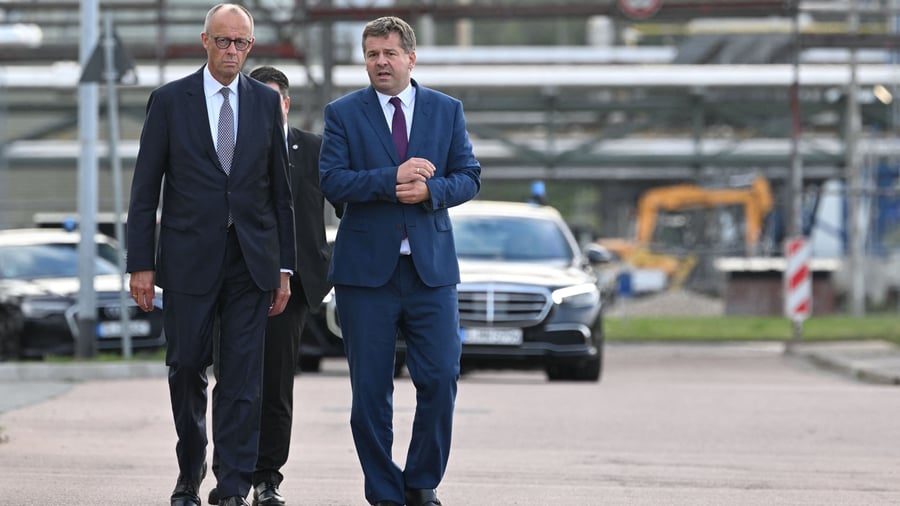
CDU's Friedrich Merz has been distancing himself from voters during his visits to Sachsen-Anhalt. He recently met with Ministerpräsident Sven Schulze (CDU) at the UPM bio-refinery in Leuna. Merz stated that "The industrial location is strong" to microphones and TV cameras. There was no audience, except for journalists and police sharpshooters perhaps due to possible drone attacks.
Merz visited Leuna twice during his campaign in Sachsen-Anhalt to support Schulze. The first visit was to the Quedlinburger Dom and the second was to the ChemiePark Leuna, the heart of Sachsen-Anhalt's industry. Both visits were well shielded from public view. Green chief Felix Banaszak had already stated that "Merz makes a campaign without voters."
In the CDU, it has been said that the chancellor limits his campaigning in Sachsen-Anhalt to a minimum and avoids appearances at market squares. A leading CDU politician said, "A chancellor who is neglected is no help." Merz also visited Mecklenburg-Vorpommern this week where he received a hostile welcome from citizens throwing confetti.
Merz was long seen as hope in the eastern CDU, who would make the party more conservative. However, little of that remains. Criticism of Merz and the federal government is high in the eastern German states, which is why Schulze distanced himself from him and his policies during his campaign. Merz warned the chancellor of the economic consequences of an AfD state government: "Whoever wants to close Germany off must know that there will be no more such investments in the future", looking at the bio-refinery.
About 1.3 billion euros has been invested by the Finnish group in Leuna over the past years, employing 220 workers. "Anyone who wants Sachsen-Anhalt to remain an attractive location must not vote for the AfD," Merz said. Schulze nodded. The economy is Schulze's main campaign issue. His message: no experiments in economically uncertain times.
But so far, it's not working. The AfD is far behind the CDU in all polls. This may also lie in the economic problems of the state: In the past 20 years, the economy grew the least in the Saarland. The number of company bankruptcies reached a new record high while investment readiness is declining - all without an AfD majority. Leuna represents the economic ups and downs.
The Chemiedreieck Halle, Merseburg, and Bitterfeld, like no other region, has been affected by the economic ups and downs since the reunification of Germany 37 years ago. Leuna alone employs nearly 15,000 people at over 100 companies, often earning above average wages. Leuna is the "largest chemical location in Germany," said Schulze.
"The chemical industry is the backbone of our economy." Leuna was also at the beginning of Chancellor Merz's tenure. Before being made chancellor, Merz practiced industrial diplomacy and called the US company Dow Chemical. Dow was considering shutting down its facilities. Merz lobbied for a new government and new energy policy, offering energy-intensive companies a perspective with a new electricity price and ending the gas price surcharge.
Dow had acquired former East German chemical conglomerates and then modernized the production sites. However, neither the chancellor's efforts nor the then economy minister Schulze's were successful: The American company will close three plants in 2027. Energy prices are too expensive and European demand is too low. The chemical industry is facing massive pressure.
At the beginning of the year, the Domo plant from Belgium could not be saved. Even though Schulze provided millions in emergency funds, a rescue company was founded, but after a few weeks it was also insolvent. The search for a private investor is ongoing. The Infra Leuna, which operates the ChemiePark and whose biggest customer is Domo, described the situation as "challenging."
Schulze said during Merz's visit that the situation is "challenging." According to the chemical industry, high energy and production costs, bureaucracy, long approval processes, and the global situation are reasons. Employment at the 130 chemical-pharmaceutical companies in Sachsen-Anhalt fell by 2.6 percent between January and May.
The former Ministerpräsident Reiner Haseloff and Schulze had already warned the federal board of the CDU over a year ago and referenced an OECD study: Sachsen-Anhalt was among the most transformation-affected economic regions in Europe. Both the chemical industry with around 20,000 direct and 100,000 indirect jobs and the automotive suppliers industry with around 25,000 direct jobs needed to reinvent themselves.
Haseloff had called for the chemical industry to be exempted from strict climate requirements. Neither green hydrogen nor green steel were currently realistic options for the industry. The industry is pushing a location and chemistry-as-a-future-employer campaign. "Sachsen-Anhalt has modern locations, qualified employees, and an industrially developed infrastructure built up over decades," said Haseloff.
Written by urgent.news from Handelsblatt's reporting — not their text. Machine-written — may contain errors; check the original before relying on it.