NASA’s Eyes software: August release notes
On August 4, 2026, a major update to Eyes on the Solar System was released that included full Mars terrain. Now you can land on the surface of Mars and explore the entire planet if you are on a desktop or laptop computer. To use the feature anywhere in the application, just hit “k” on […] The post NASA’s Eyes software: August release notes appeared first on NASA Science .
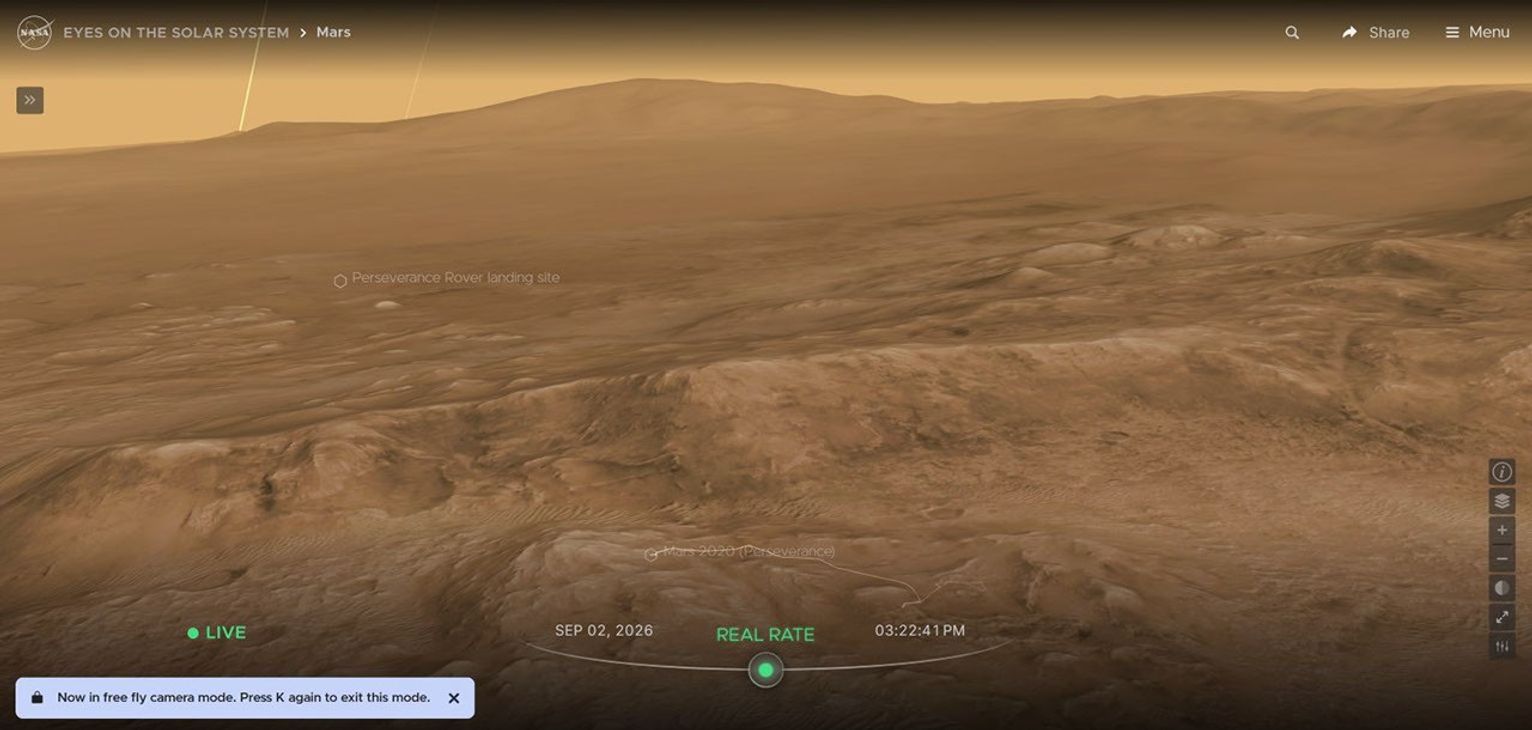
On August 4, 2026, NASA released an update to Eyes on the Solar System that introduced a new free-fly mode allowing users to explore Mars in full detail. By pressing the "k" key, the user enters free-fly mode, indicated by a message in the application. With the mouse, users can click and drag the view, moving around with W, A, S, and D keys.
Holding the Shift key accelerates movement. Additionally, the Q/E and Z/C keys adjust the camera view's up/down orientation and rolling respectively. The new feature is applicable anywhere in the Solar System at any time. Upon exiting free-fly mode, pressing "k" brings the user back to normal viewing.
Apart from the free-fly mode, the update incorporated the Roman Space Telescope prior to its launch and adjusted its trajectory on launch day, August 30, 2026. The application also welcomed the SOLAR-1 spacecraft and introduced Lagrange points L1 and L2, which users can now visit. The SOLAR-1 observatory is currently stationed at Lagrange point one.
Alongside Eyes on the Solar System, the Eyes team published a significant dataset in Eyes on the Earth on August 31, 2026. This included the NISAR mission's radar reflectivity map, the most detailed dataset ever added to Eyes on the Earth. It presents a rolling 12-day radar reflectivity map with 15-meter per pixel resolution, enabling the observation of individual cargo ships in major global ports.
Written by urgent.news from NASA Science's reporting — not their text. Machine-written — may contain errors; check the original before relying on it.