NASA wires up Dragonfly and names the landing area
Titan-bound rotorcraft set for launch in 2028
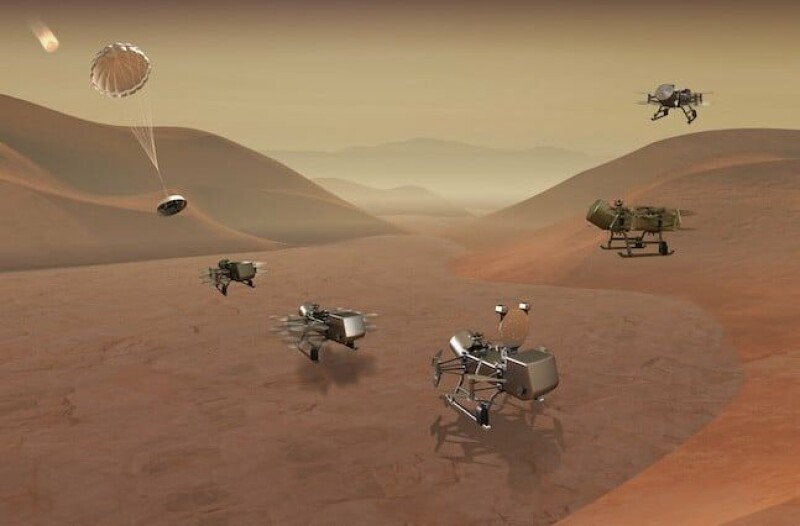
NASA has assigned a name to the Titan dune field where their Dragonfly rotorcraft will land in 2034: Ahmakiq Undae. The International Astronomical Union (IAU) approved this name, and NASA announced it as the spacecraft's 2028 launch approaches. Scheduled to arrive at Saturn's moon Titan in late 2034, Dragonfly's construction started in late 2024 and was completed about a year later.
The probe, which weighs about 100 pounds, includes a wiring harness with an estimated 17,315 feet of conductor wire and 374 connectors. Dragonfly will explore diverse environments on Titan, from organic dunes to ancient impact crater deposits where liquid water and complex organic materials were once present. The probe will maintain temperatures as low as minus 290 degrees Fahrenheit and needs a heat shield to protect it during its descent through Titan's dense atmosphere.
Dragonfly is a flying laboratory designed to explore multiple locations during its mission. Its total lifecycle cost was $3.35 billion, and the mission was two years late due to various factors including the COVID-19 pandemic, supply-chain issues, and additional design work. The launch is currently scheduled for no earlier than July 2028 on a SpaceX Falcon Heavy rocket.
Written by urgent.news from The Register Science's reporting — not their text. Machine-written — may contain errors; check the original before relying on it.
This story
This is one outlet's version. Read the fullest account.
- NASA’s Dragonfly Gets Wired Up While Titan Landing Area Is Named science.nasa.gov
- NASA wires up Dragonfly and names the landing area theregister.com