Hubble's superbubble scene
Image: This sprawling cosmic vista and subject of today’s ESA/Hubble Picture of the Month comes from the Large Magellanic Cloud (LMC). The LMC is the largest of the small galaxies that orbit our Milky Way galaxy . At just 160 000 light-years away, the LMC offers a close look at highly active stellar birthsites like the nebula shown here. This nebula is named LHA 120-N44, or N44 for short, and…
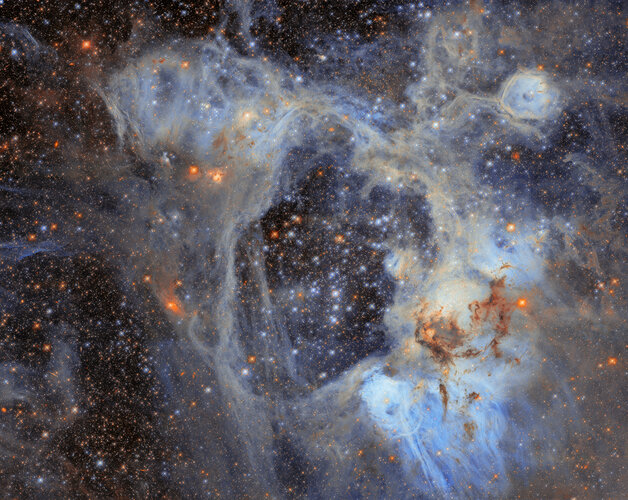
The Large Magellanic Cloud (LMC), a nearby satellite galaxy of our Milky Way, showcases a stunning nebula in a recent Hubble Space Telescope image. Known as LHA 120-N44 or simply N44, this nebula is characterized by a central void and an encompassing shell of dense, dusty gas. The void, a colossal 'superbubble' of approximately 210 by 140 light-years, was hollowed out by the powerful stellar winds and supernovae explosions of its central star cluster.
These stellar outbursts expelled much of the surrounding gas, which subsequently coalesced into a shell that now harbors new stars. This nebula provides astronomers with an ideal laboratory to study the stages of star formation, from the collapse of cold gas clouds into dense knots to the ignition of nuclear fusion in newborn stars.
By observing nearly half a million stars within N44, researchers have cataloged over 30,000 pre-main-sequence stars, which have yet to begin fusing hydrogen into helium in their cores. These observations, made possible by Hubble's high sensitivity and fine spatial resolution, shed light on the duration of the star formation process and the typical masses of newborn stars.
The data collected also allows for the study of regions like the LMC and early galaxies, which are poor in elements heavier than helium, offering a unique perspective on the primordial stages of star formation.
Written by urgent.news from ESA Space Science's reporting — not their text. Machine-written — may contain errors; check the original before relying on it.