Hubble spots a mysterious 10-sided 'decagon' growing around Saturn's south pole
The Hubble Space Telescope spied a large atmospheric phenomenon on Saturn: a decagon surrounding the south pole.
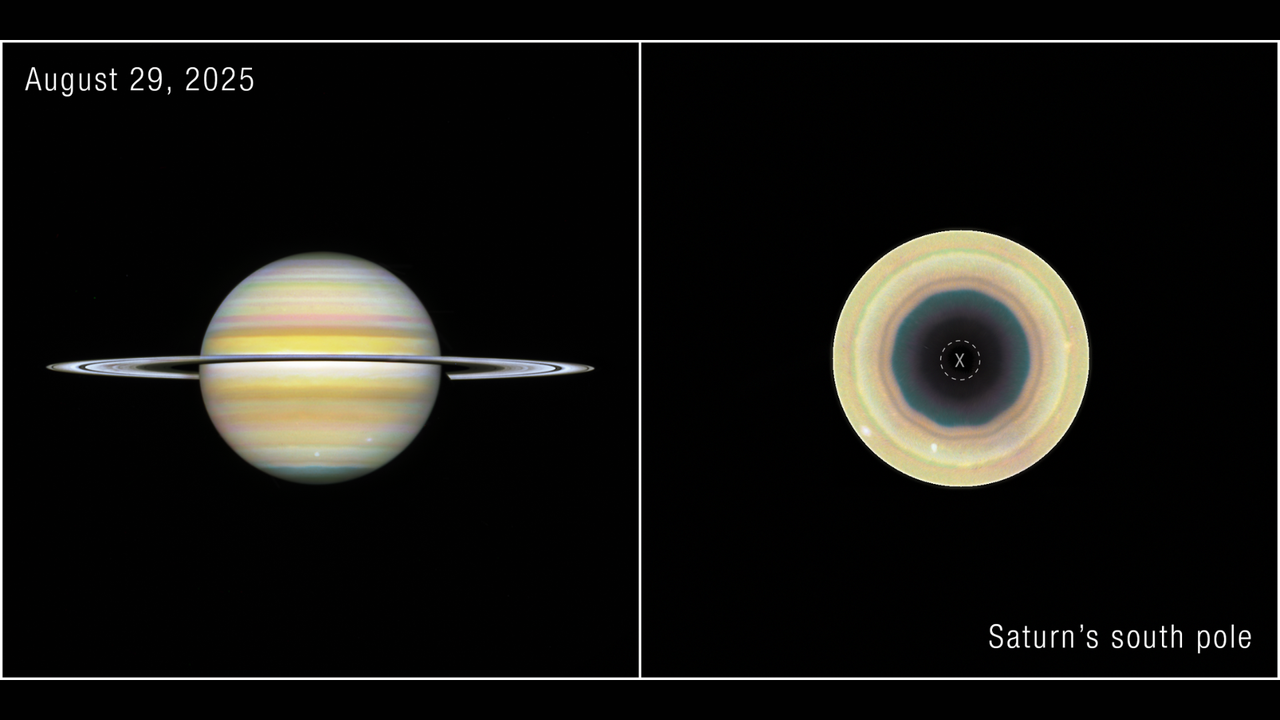
A sudden 10-sided decagon has emerged around Saturn's south pole, according to recent observations from the Hubble Space Telescope. The striking atmospheric wave, which likely formed in 2023, is visible through several layers of Saturn's atmosphere, extending beyond the cloud tops. This distinctive feature, unlike the long-standing hexagon at Saturn's north pole, has been observed for the first time.
Scientists are puzzled by its rapid emergence, as the planet's northern hexagon has been present for over 40 years. Amy Simon, a senior scientist at NASA's Goddard Space Flight Center, expressed their surprise, stating that "this feature is different—it appears to be strengthening, giving us the rare opportunity to watch a giant atmospheric pattern develop."
The Hubble Space Telescope, part of NASA's Outer Planet Atmospheres Legacy program, has captured high-resolution images of the wave across multiple years, providing a unique chance to study its development. The wave's formation coincides with Saturn's south pole being visible from Earth, thanks to the planet's 29-year orbit around the sun.
While ground-based observatories and amateur astronomers first spotted hints of this decagon in 2024, Hubble was able to obtain clearer images this year, free from Earth's atmosphere. The Cassini spacecraft, which orbited Saturn between 2004 and 2017, did not detect the feature, suggesting it hadn't started forming yet. Scientists anticipate further observations with Hubble and the James Webb Space Telescope to better understand the decagon's origin and its implications for atmospheres on gas giants like Saturn.
Written by urgent.news from Live Science's reporting — not their text. Machine-written — may contain errors; check the original before relying on it.
This story
This is one outlet's version. Read the fullest account.
- Hubble tracks new decagon encircling Saturn’s south pole esa.int
- Hubble tracks new decagon encircling Saturn's south pole phys.org
- Saturn’s south pole decagon confirmed! A mysterious 10-sided figure earthsky.org
- NASA’s Hubble Tracks New Decagon Encircling Saturn’s South Pole science.nasa.gov
- A Mysterious Decagon Unexpectedly Appeared Around Saturn's South Pole. The Ten-Sided Shape Seems to Be a Wave in the Atmosphere smithsonianmag.com
- Hubble Images Uncover Massive 10-Sided Wave Brewing at Saturn's South Pole discovermagazine.com
- New Hubble images reveal a bizarre decagon over Saturn’s south pole sciencenews.org
- Saturn has a big, weird decagon around its south pole newscientist.com