Hubble tracks new decagon encircling Saturn’s south pole
Recent observations with the NASA/ESA Hubble Space Telescope have revealed a giant, evolving 10-sided atmospheric wave encircling Saturn’s south pole. This discovery marks the first time a large regular-sided jet pattern has been observed in the planet’s southern hemisphere. The feature appears remarkably similar to Saturn’s famous hexagon at its northern pole, but is also distinctly different,…
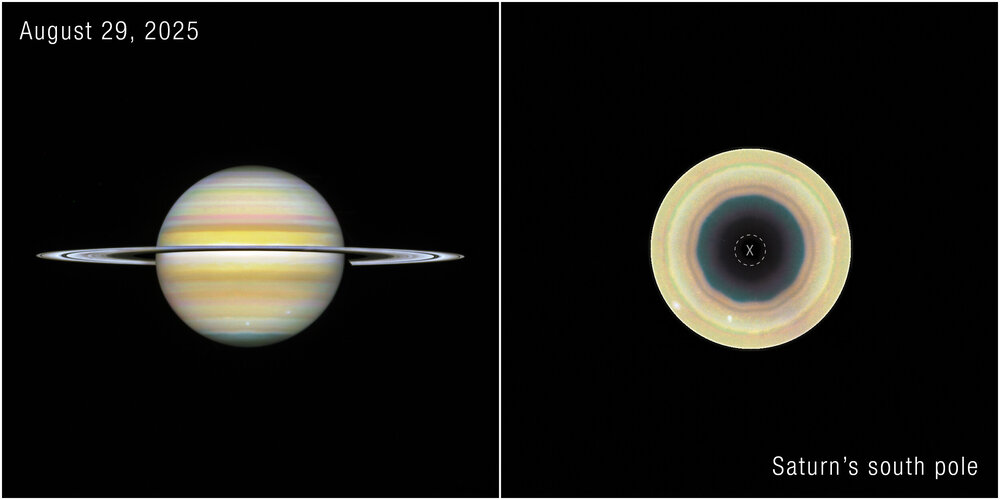
Saturn has developed a peculiar geometric pattern resembling a decagon near its southern hemisphere, as observed by the Hubble Space Telescope on August 29, 2025. This unusual weather phenomenon may have originated from a massive storm in the vicinity, though researchers are still uncertain about the exact cause. The pattern, characterized by its clear edges and 10 sides and angles, forms like a decagon when viewed from above, similar to a hexagonal weather pattern first identified at Saturn's northern pole more than four decades ago.
Amy Simon, a researcher at NASA’s Goddard Space Flight Center in Maryland, notes that the decagon is slightly wider than Earth, spanning approximately 13,000 kilometers. The pattern appears to be shifting along with Saturn's rotation. Initially discovered by amateur astronomers in 2024, the existence of the decagon was confirmed through images captured by Hubble from 2023 to 2025 by a team led by Agustín Sánchez-Lavega from the University of the Basque Country in Spain.
The formation of this new feature is unexpected, as no spacecraft has orbited Saturn since 2017. While the exact timing of its development remains unclear, the decagon is believed to be the result of a large atmospheric wave influenced by powerful jet streams near the south pole, possibly triggered by a nearby storm. This discovery underscores the dynamic nature of Saturn, highlighting that the planet continues to evolve and reveal new phenomena.
No comparable pattern has been observed on any other planets, although Jupiter exhibits cyclones at its poles. The researchers anticipate that ongoing observations, including those from the James Webb Space Telescope, will provide further insights into the decagon's behavior and longevity, with many scientists eagerly awaiting access to these data.
Written by urgent.news from New Scientist's reporting — not their text. Machine-written — may contain errors; check the original before relying on it.
This story
This is one outlet's version. Read the fullest account.
- Hubble tracks new decagon encircling Saturn's south pole phys.org
- Saturn’s south pole decagon confirmed! A mysterious 10-sided figure earthsky.org
- NASA’s Hubble Tracks New Decagon Encircling Saturn’s South Pole science.nasa.gov
- A Mysterious Decagon Unexpectedly Appeared Around Saturn's South Pole. The Ten-Sided Shape Seems to Be a Wave in the Atmosphere smithsonianmag.com
- Hubble Images Uncover Massive 10-Sided Wave Brewing at Saturn's South Pole discovermagazine.com
- New Hubble images reveal a bizarre decagon over Saturn’s south pole sciencenews.org
- Saturn has a big, weird decagon around its south pole newscientist.com
- Hubble spots a mysterious 10-sided 'decagon' growing around Saturn's south pole livescience.com