2 spacecraft will soon reach Mercury after 8 years in space. Here's what BepiColombo can do
After an 8-year trek to Mercury, BepiColombo will finally split into two spacecraft ready to track down the secrets of the least-explored planet in the inner solar system.
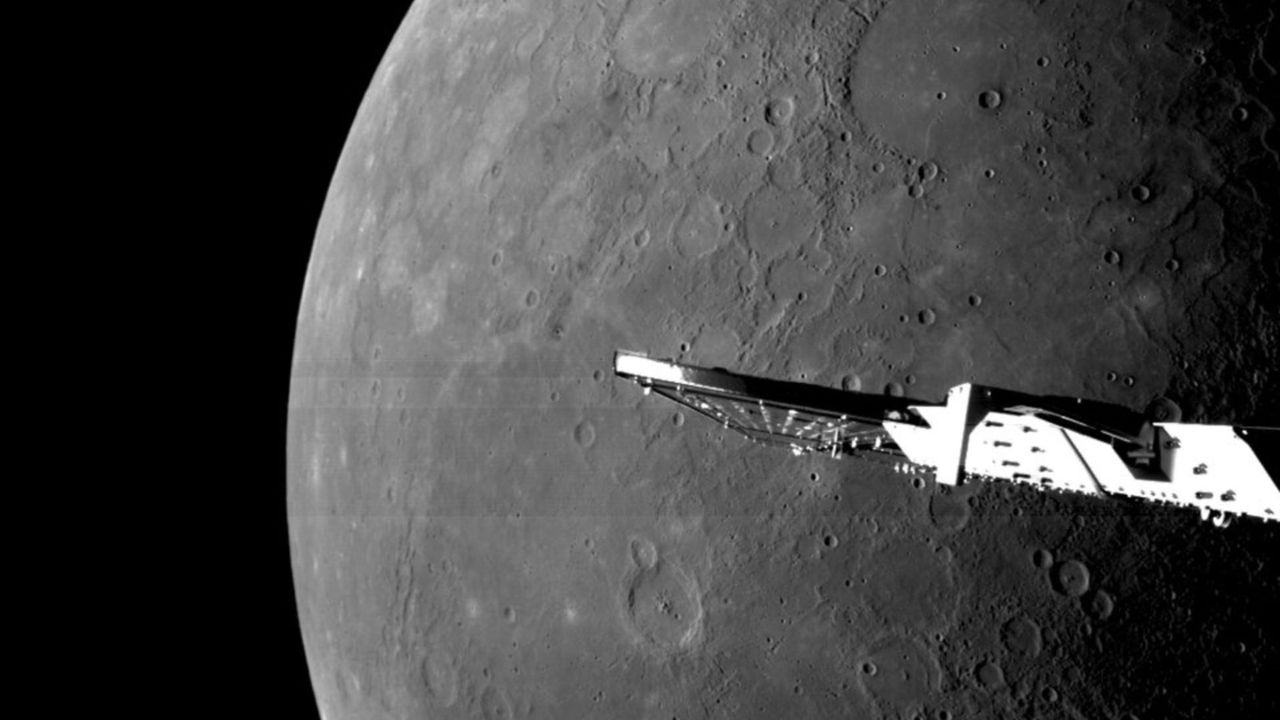
Mercury, the tiniest and least-understood planet in the inner solar system, is about to have its secrets unlocked by two spacecraft. The BepiColombo mission, a joint venture between the European Space Agency (ESA) and Japan Aerospace Exploration Agency (JAXA), launched in 2018. After a challenging journey through the inner solar system, the mission will separate its science equipment from the transport that carried it on September 3, 2023.
By April 2027, scientists anticipate that the mission's two instrument-laden probes will be collecting data that could shed light on Mercury's enigmatic nature and potentially the solar system itself.
An enigmatic planet, Mercury has long been visited by only two missions to date. NASA's Mariner 10 spacecraft conducted three flybys in 1974 and 1975, providing the first close-up views of the planet's cracked and cratered surface, as well as confirming the existence of a tenuous atmosphere and magnetic field. However, MESSENGER, a NASA spacecraft launched in 2011 with principal investigator Sean Solomon, remained the most comprehensive explorer of Mercury until now.
MESSENGER, after four years of observations, offered the first complete surface map of the planet and made several discoveries that hinted at the planet's strange characteristics, such as the presence of "hollows" (bright, steep-sided pits) and a higher-than-expected abundance of volatile elements on its surface. MESSENGER's orbit also left the southern hemisphere unexplored, casting a shadow over much of the planet.
With BepiColombo, scientists hope to address these mysteries. The mission consists of two separate spacecraft, each with a specific focus. Europe's Mercury Planetary Orbiter (MPO) will study the planet's terrain, minerals in the crust, gravity field, and the effects of solar particles on Mercury. Japan's Mercury Magnetospheric Orbiter (Mio), on the other hand, will investigate the planet's magnetosphere, atmosphere, and dust environment.
Both spacecraft will also measure the planet's magnetic field, offering simultaneous observations of different parts of the field.
Written by urgent.news from Space.com's reporting — not their text. Machine-written — may contain errors; check the original before relying on it.