Tuning frustrated magnetism with stress
Uniaxial stress induces a new magnetic phase in PdCrO₂, revealing strong coupling between magnetic order, electronic structure and lattice elasticity The post Tuning frustrated magnetism with stress appeared first on Physics World .
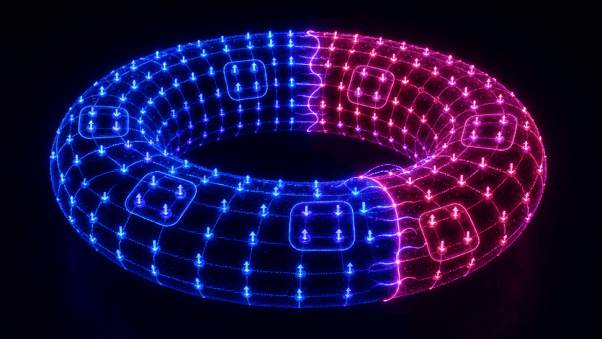
In antiferromagnets, neighbouring spins tend to align in opposite directions to minimize their energy. However, in geometrically frustrated magnets, this is not always achievable; for instance, three spins on a triangle cannot simultaneously be antiparallel. PdCrO2, a compound containing chromium (Cr) atoms on a triangular lattice and sheets of palladium (Pd) atoms with high electrical conductivity, serves as an excellent example of such a system.
The magnetic moments on the Cr atoms cannot point antiparallel to each other due to the triangular arrangement. PdCrO2 is particularly useful for studying the interaction between magnetism and electronic structure with precision. Research has shown that the Cr-Cr exchange interaction is highly sensitive to inter-atomic spacing, causing the magnetic ordering wavevector to shift rapidly when uniaxial stress is applied to PdCrO2, distorting the triangular lattice.
In this study, researchers further manipulated the magnetic structure by applying sufficient stress to qualitatively alter it. By employing X-ray diffraction, measuring the stress-strain relationship, and elastic neutron scattering, they investigated the impact on the elastic properties and the changes in magnetism. Upon applying stress to PdCrO2, the magnetic wavevector changes rapidly, indicating the Cr-Cr exchange interaction's sensitivity to strain.
The main discovery of this research is that, under a uniaxial stress of approximately 0.6 GPa, the magnetism transitions into a state with a rigid magnetic wavevector, meaning it no longer responds to further lattice strain changes. This rigidity is evident in the elastic properties: the Young's modulus nearly doubles, and the Poisson ratio decreases from an exceptionally high value of about 0.7 to around 0.3, which is more typical.
This rigidity may be due to nesting, where the wavevector of the stress-induced magnetic phase aligns the Fermi surface of the Pd sheets. PdCrO2 thus offers a system for studying the thermodynamics of nesting with quantitative precision. More broadly, this work demonstrates that uniaxial stress is a powerful tool for tuning frustrated magnetism and accessing new magnetic states.
Written by urgent.news from Physics World's reporting — not their text. Machine-written — may contain errors; check the original before relying on it.