Probing quantum critical points
A new Quantum Monte Carlo method reveals distinct entanglement signatures of different quantum critical points The post Probing quantum critical points appeared first on Physics World .
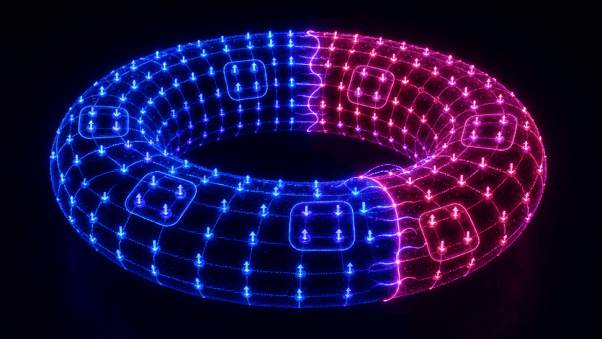
At absolute zero temperature, materials undergo a phase change, transitioning from ordered to disordered states. In the quantum realm, this occurs at a quantum critical point, which is triggered by factors other than temperature, such as magnetic fields or interaction strengths. Among these quantum critical points, entanglement entropy serves as a crucial indicator, representing the degree of quantum information shared between system components.
In two-dimensional quantum systems, calculating entanglement entropy precisely at these critical points is a formidable challenge.
To address this challenge, researchers employed a novel Quantum Monte Carlo algorithm. This algorithm leverages random sampling to analyze complex quantum systems that defy exact solutions. Starting with a standard quantum magnet model, the transverse-field Ising model, the researchers introduced additional interactions to investigate various phase transitions, including ordinary Ising critical points and a tricritical point. In (2+1) dimensions, the tricritical point is characterized by a Gaussian free theory.
By comparing the second Rényi entanglement entropies of two selected regions with equal boundary lengths, the researchers effectively isolated the dominant area-law contribution, thereby revealing the universal corner term as the leading signal. This technique yielded precise values for the Ising critical point and demonstrated that different quantum critical behaviors, such as the Ising and tricritical/Gaussian critical points, exhibit distinct entanglement fingerprints.
Consequently, entanglement proves to be an invaluable tool for distinguishing between various quantum critical phenomena and for testing theoretical predictions in two-dimensional quantum materials.
Written by urgent.news from Physics World's reporting — not their text. Machine-written — may contain errors; check the original before relying on it.