木卫一隐藏热源首次曝光
朱诺号探测器的数据还表明,木星的这颗卫星拥有相对平坦、密度较低的表面。
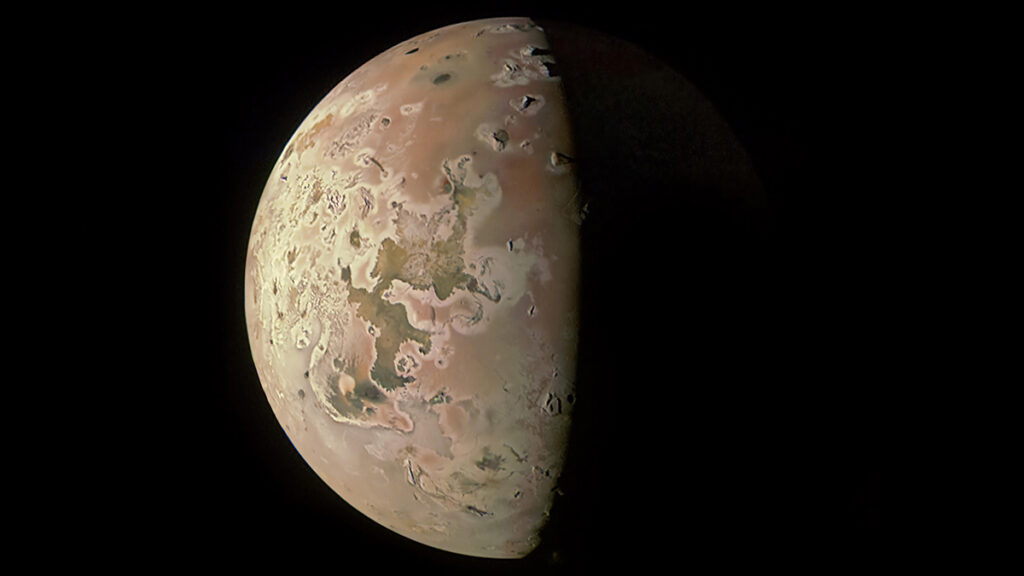
Io, Jupiter's third-largest moon, experiences constant gravitational forces from Jupiter and its other moons, Europa and Ganymede, causing tidal forces that generate extreme internal temperatures and result in volcanic activity across its surface. Io's volcanic activity is more intense than any other celestial body in the solar system.
Prior observations of Io's temperature have relied on infrared measurements, which can only detect the temperature of Io's outer layer, or "skin." Now, researchers have measured the internal temperature of Io for the first time.
Using data collected by NASA's Juno spacecraft during close flybys of Io in December 2023 and February 2024, researchers analyzed microwave radiation emitted from Io's surface. This wavelength is longer than infrared, allowing scientists to observe depths of tens of meters beneath Io's surface. The researchers identified and removed interference signals caused by reflections from the sky to ensure the observations accurately reflect Io's characteristics.
The observed data suggests that the upper tens of meters of Io's surface have been strongly heated internally. Two possible explanations exist: heat could be continually rising through a shallow thermal layer near the surface, or recent lava flows or heat jets from the core could have dispersed their heat through a thin crust to the surface.
Given Io's towering mountains, the latter explanation seems more likely. Further analysis of the microwave observations revealed that Io's surface is relatively flat, similar to Earth's plains. The upper layer's density is also lower than solid rock, possibly similar to volcanic ash or floating rocks, and likely sits atop denser material beneath a few meters.
Written by urgent.news from Eos's reporting — not their text. Machine-written — may contain errors; check the original before relying on it.