Congo's Ebola death toll crosses 3,000 amid worst outbreak in country's history
More than 6,100 Ebola cases and 3,000 deaths are recorded in the Democratic Republic of Congo. Weak surveillance and insecurity hinder efforts to contain the nation's worst-ever epidemic. Schools have reopened amid concerns about potential transmission within classrooms. No approved vaccine exists for the Bundibugyo species, though some are in development. Britain has pledged over fifty million…
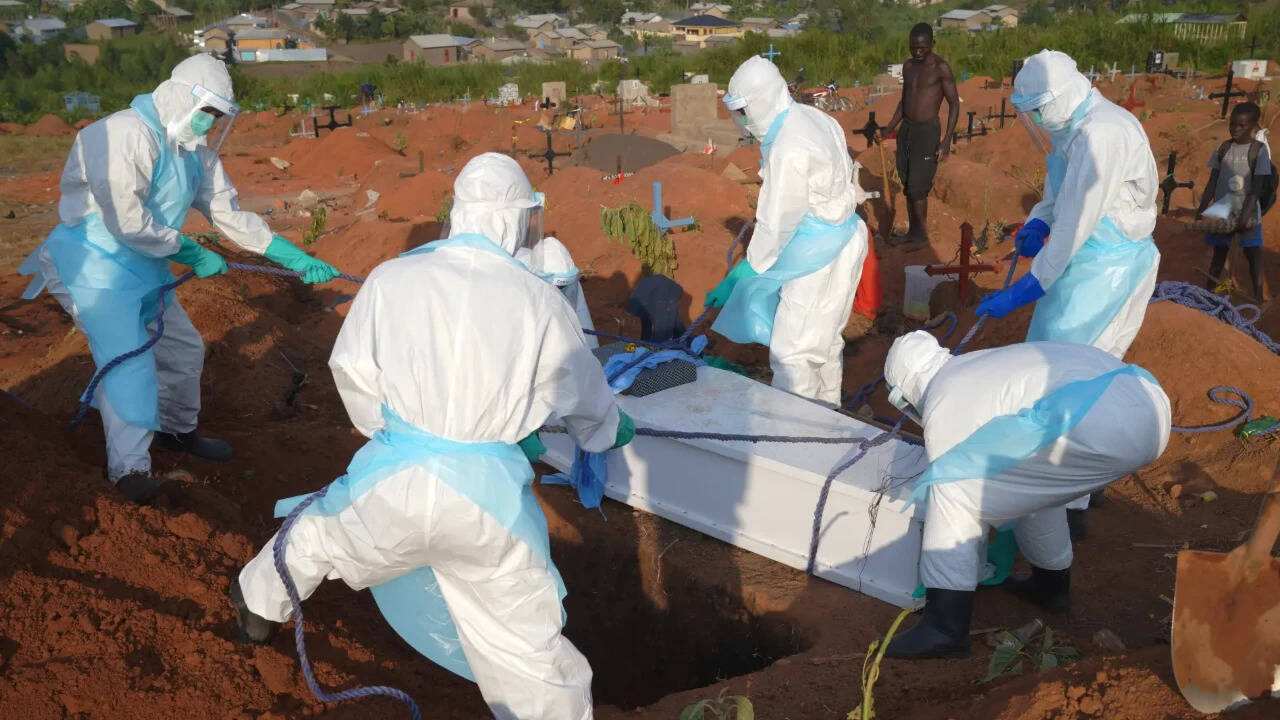
Congo's Ebola outbreak has claimed over 3,000 lives among more than 6,100 confirmed cases, according to the latest government figures released on Wednesday. The disease is spreading at an alarming rate, outpacing efforts to control it. As of mid-May, when it was declared a global health emergency, the outbreak has recorded 6,186 confirmed cases, with 3,007 fatalities.
Jean-Claude Angwanzia, a resident of Bunia, recounted his decision to leave the epicenter of Ituri province due to safety concerns. He expressed his fear, noting that he rarely encountered health workers and that infected bodies were being mishandled.
Public transportation driver Papy Baraka also highlighted the impact of the outbreak on daily life, revealing that he had reduced the number of passengers he transports due to the heightened risks.
Recent weeks have seen a surge in new cases, with two additional health zones affected in North Kivu province. The fatality rate in this region is significantly higher than in other affected provinces. The virus has now spread to six provinces.
The U.S. Centers for Disease Control reported on Tuesday that the containment efforts "remained below established response targets," and the rapid expansion of the disease across numerous health zones indicates "uncontrolled expansion of the outbreak." The report suggested that most cases were occurring outside known transmission chains, primarily due to only 15% to 20% of confirmed new cases coming from known contacts.
The World Health Organization's Director-General, Dr. Tedros Adhanom Ghebreyesus, acknowledged the existence of chains of transmission that health authorities are unaware of. He emphasized that until every chain is identified and stopped, the epidemic will continue to pose a threat to the Democratic Republic of Congo (DRC), its neighboring countries, and the entire region.
Health workers are struggling under challenging conditions and have gone on strike multiple times to demand better pay. The rapid spread of the disease can be attributed to various factors, including conflict in the eastern region, attacks on health workers, the constant movement of miners, and inadequate health infrastructure. The resumption of school during the outbreak has also raised concerns about transmission in classrooms.
The World Health Organization stated that the outbreak is on track to surpass the deadliest on record, the 2014-2016 West Africa regional outbreak, which claimed 11,000 lives. The Africa Centers for Disease Control and Prevention suggested that the outbreak may be three times larger than the recorded cases due to weak surveillance and contact tracing.
Despite this, the outbreak has already become Congo's deadliest Ebola outbreak. There is currently no vaccine or approved treatment for the Bundibugyo virus causing the current outbreak. However, a vaccine called Ervebo is being distributed to front-line health workers in Kisangani in the northeastern Tshopo region.
Written by urgent.news from Winnipeg Free Press's reporting — not their text. Machine-written — may contain errors; check the original before relying on it.
This story
This is one outlet's version. Read the fullest account.
- Congo’s Ebola outbreak shows no signs of slowing as deaths top 3,000 winnipegfreepress.com
- Congo Ebola death toll surpasses 3,000 as outbreak spreads across six provinces dailypost.ng
- Schools resume classes in Congo’s Ebola epicenter despite concerns from parents and teachers apnews.com
- Ebola death toll tops 3,000 in Congo outbreak thehill.com
- Congo's Ebola outbreak shows no signs of slowing as deaths top 3,000 medicalxpress.com
- Overcrowded Ebola treatment centers are fueling transmission in the Democratic Republic of the Congo nature.com
- UK pledges additional £50 million to help contain Ebola outbreak in Congo myjoyonline.com
- Ebola death toll passes 3,000 in DR Congo: official data thehindu.com