Why Enterprise AI Fails: The Hidden Trap of Pure Probabilistic LLMs and the Rise of Neuro-Symbolic Architecture
The modern enterprise software landscape sits at a precarious crossroads. For the past few years, the narrative around artificial intelligence has been dominated by neural scaling laws. We have watched Large Language Models (LLMs) scale from niche research projects into trillion-parameter juggernauts capable of writing code, summarizing massive legal briefs, and holding surprisingly nuanced…
The modern enterprise software landscape is at a critical juncture. For years, the artificial intelligence narrative has been centered around neural scaling laws. Large Language Models (LLMs) have grown from niche research projects to trillion-parameter models, capable of generating code, summarizing legal briefs, and engaging in nuanced conversations.
However, as these models transition from sandboxed chat interfaces to mission-critical enterprise workflows, including financial reconciliation, clinical diagnostics, regulatory compliance auditing, and automated supply chain execution, a troubling truth emerges. Pure probabilistic Large Language Models (LLMs) are fundamentally unsuitable for mission-critical applications.
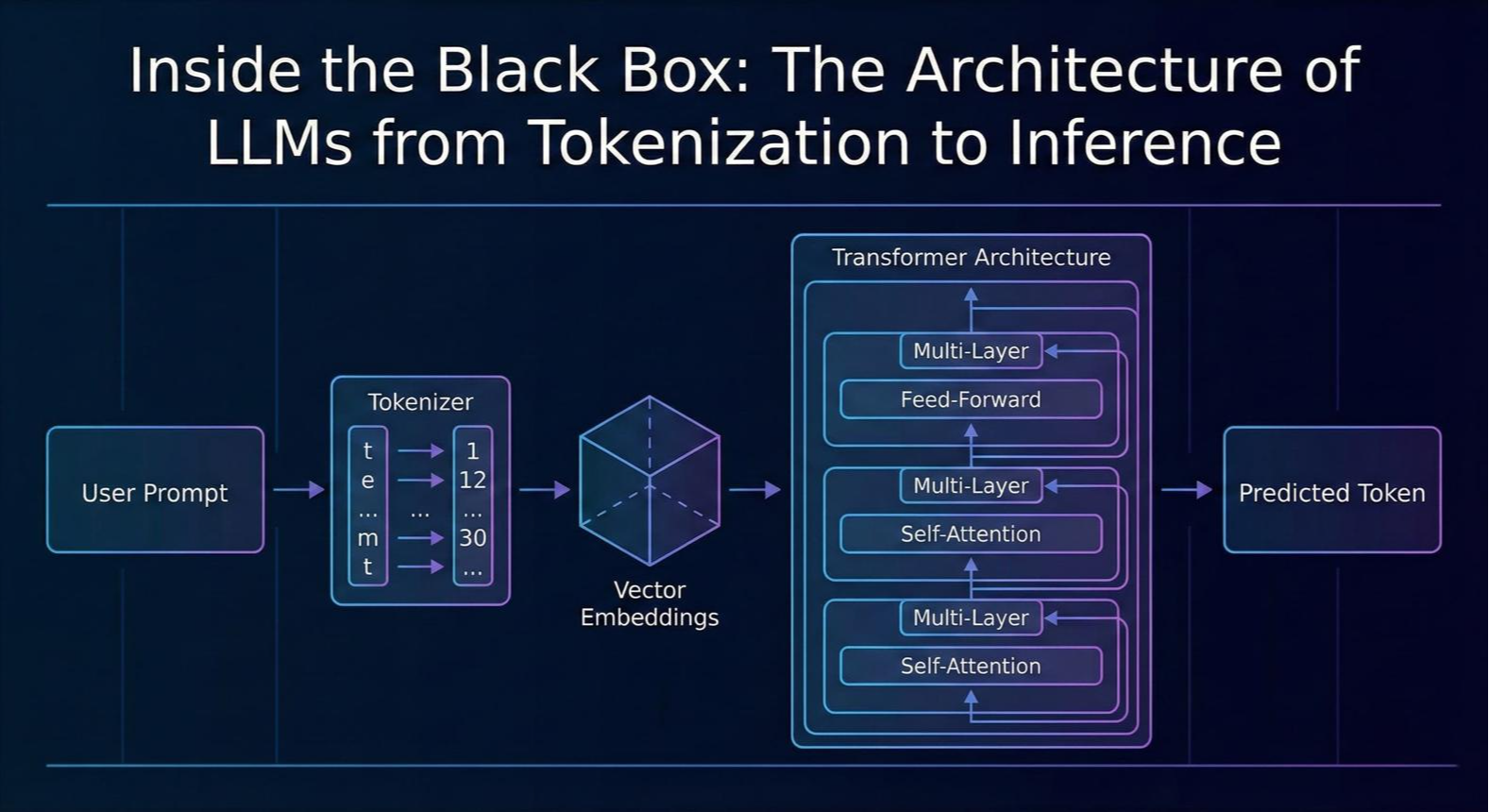
To comprehend why, one must look beyond marketing hype and analyze the architecture of these models. At their core, LLMs are high-dimensional probability engines. They process sequences of tokens, project them into dense vector spaces, and navigate those spaces using learned weights to predict the next token. While this statistical fluency has enabled remarkable advancements in natural language understanding, it presents a critical architectural flaw: probabilistic indeterminism.
Unlike humans, who have structured mental models of rules, axioms, and constraints, LLMs possess correlational weight matrices. When an LLM generates a response, it is performing a stochastic sampling operation over a probability distribution. The model lacks internal mechanisms to differentiate between verified historical transactions and plausible-sounding hallucinations.
To effectively bridge the gap between probabilistic creativity and deterministic enterprise requirements, software architects must move beyond pure neural scaling. They must explore the theoretical foundations of Neuro-Symbolic AI—a paradigm that combines the pattern-matching flexibility of neural networks with the rigorous, rule-bound determinism of symbolic logic.
Understanding why enterprise systems struggle when relying solely on foundational LLMs requires examining the epistemological nature of neural generation. Epistemology is the philosophical study of knowledge—how it is acquired, justified, and distinguished from belief. In contrast to human experts who operate within a domain with structured mental models of explicit rules and logical deduction, a pure probabilistic LLM possesses no internal symbolic knowledge base.
When a user prompts the model, it calculates vector similarities across billions of parameters to generate a response based on co-occurrences in its training corpus. This architectural reality results in three systemic vulnerabilities in enterprise architectures: the hallucination vector, the opacity problem (black box nature), and catastrophic forgetting with non-compositionality.
The hallucination vector refers to the model's propensity to interpolate missing information, generating fictitious data when it encounters unfamiliar scenarios. This is problematic in regulatory filings where the model must output, "I do not know," rather than fabricated financial figures. The opacity problem arises because enterprise applications consume LLM outputs as plain text, lacking insight into the intermediate reasoning process.
There is no clear execution stack or formal proof, making it difficult to trace how the model arrived at its conclusions. Finally, neural networks struggle with compositionality—the ability to combine known concepts in novel ways—leading to catastrophic forgetting when enterprise rules change. In comparison to web development, unmanaged state akin to pure probabilistic LLMs is analogous to loosely typed client-side objects without schemas.
This mirrors the engineering pitfall of managing all application state within a single, mutable global object. Such an approach is precisely how pure probabilistic LLMs operate, with data flowing freely without rigorous validation schemas.
Written by urgent.news from Dev.to's reporting — not their text. Machine-written — may contain errors; check the original before relying on it.