What Happens Inside an LLM When You Type “Hello”?
A beginner-friendly walkthrough of how LLMs turn text into tokens, embeddings, attention patterns, probabilities, and generated responses.
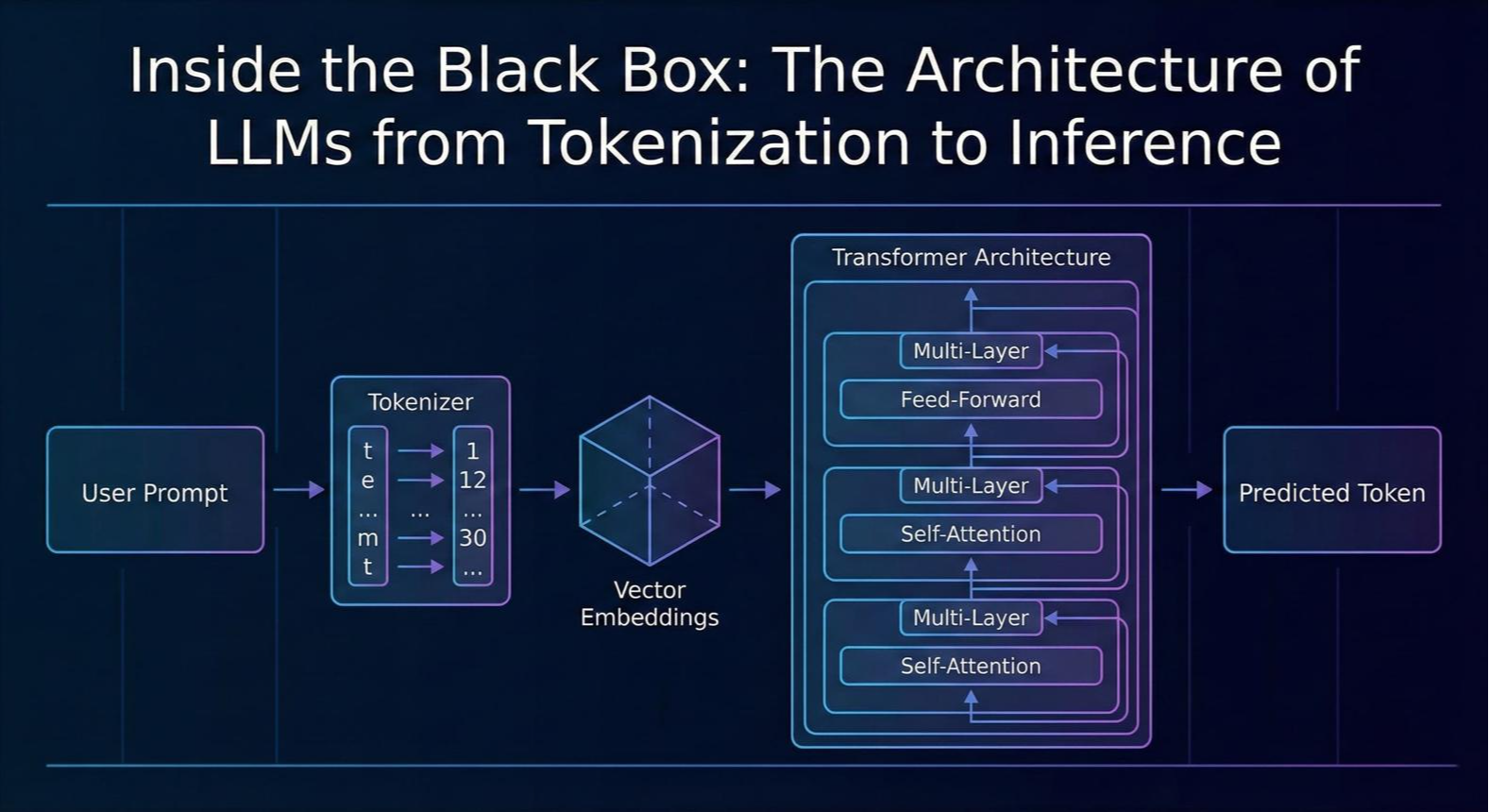
When you type "Hello" into an AI assistant like ChatGPT, Claude, or Gemini, the process that unfolds behind the scenes is quite intricate. Although it may seem straightforward, a multitude of stages involving tokenization, embeddings, neural networks, attention, probabilities, and token generation take place. At the heart of this procedure lies the Transformer architecture, first introduced in 2017 through the research paper "Attention Is All You Need."
The journey begins with the human language you provide. For instance, "Hello, how are you?" appears to humans as a coherent sentence composed of words. However, computers operate with numbers, so the model must convert the text into a numerical representation. This initial step involves tokenization, where the model breaks the sentence into smaller units called tokens.
These tokens can be complete words, parts of words, punctuation, or frequently occurring text fragments. The specific tokenization method varies depending on the model and tokenizer used.
Once the sentence is tokenized, the model assigns numerical values to the tokens, known as embeddings. An embedding is essentially a long list of numbers representing information about a token. For example, instead of directly processing the word "Hello," the model might internally work with something analogous to [0.21, -0.14, 0.87, 0.03, ...]. The actual representation is far more complex, as the model uses much larger vectors to capture intricate linguistic patterns.
At this point, the Transformer architecture comes into play, which is a pivotal component of modern AI language models. The Transformer, introduced in the 2017 paper "Attention Is All You Need," uses attention mechanisms to understand the context and relationships between different parts of a sentence. Self-attention enables the model to assign varying levels of importance to different tokens, helping it comprehend the meaning and context of the input.
The attention process involves calculating three key components: Query (Q), Key (K), and Value (V). The model assesses how strongly different tokens should interact with each other and combines the relevant information accordingly. This allows the model to create a richer representation of each token based on its surrounding context.
Moreover, the Transformer architecture employs multi-head attention, where multiple attention heads process the sentence from different perspectives. Each head specializes in different aspects, such as grammar, nearby words, long-range relationships, or meaningful patterns, enabling the model to capture complex linguistic nuances.
Before the model processes your "Hello," it undergoes a significant training phase called pre-training. During this stage, the model learns the typical patterns and structures of human language by predicting the next word in a sequence. This extensive training equips the model with the knowledge necessary to respond meaningfully to your input.
In summary, when you type "Hello," the AI assistant undergoes a sophisticated journey within its internal workings. From tokenization and embeddings to the Transformer architecture's attention mechanisms, the process leverages complex numerical representations and algorithms to generate a coherent response. This intricate interplay of processes enables AI systems to understand and generate human language with remarkable proficiency.
Written by urgent.news from HackerNoon's reporting — not their text. Machine-written — may contain errors; check the original before relying on it.