Switching gravity on and off leaves particles behind, mathematical model finds
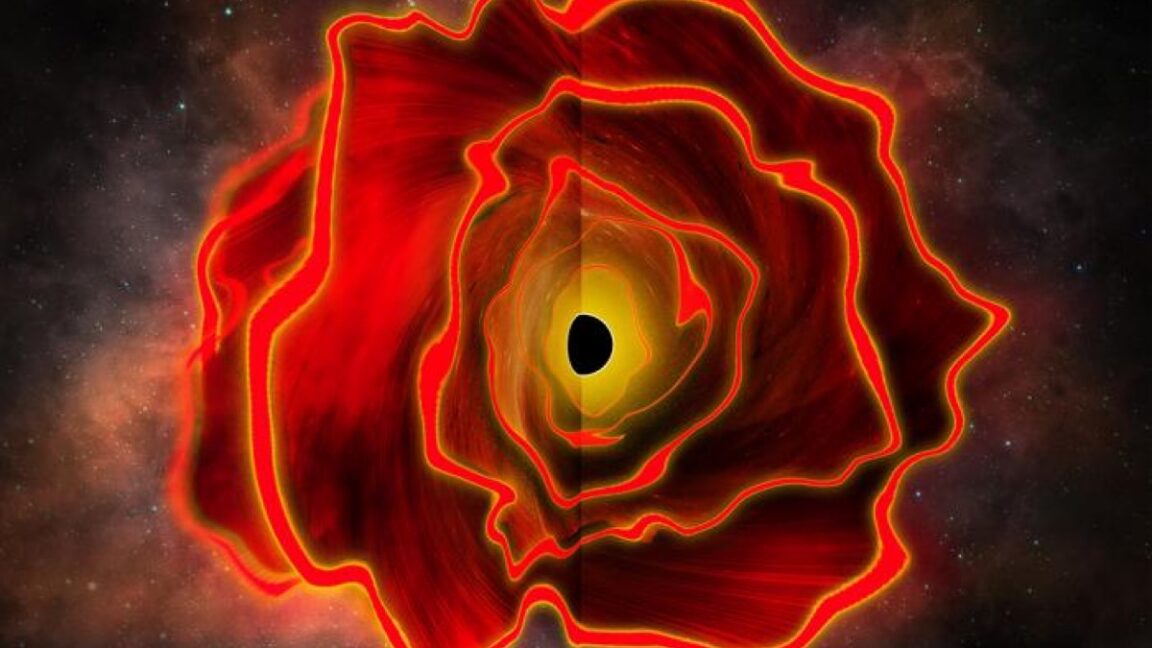
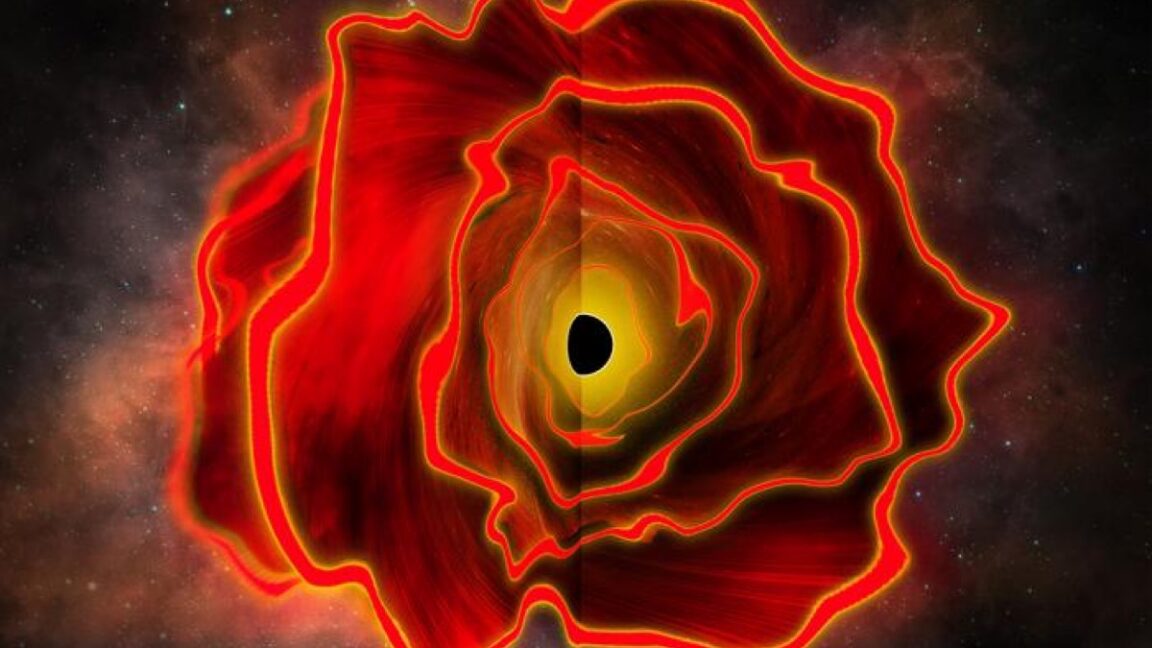
Hawking radiation causes black holes to eventually evaporate. This is because particle pairs are spontaneously created near the event horizon (the position of the last ray of light that can escape the black hole's gravitational pull). A particle and its antiparticle are created for a brief moment and disappear immediately afterward. But sometimes a particle falls into the black hole, allowing the…

A team of astronomers and mathematicians from Radboud University have developed a mathematical model demonstrating that temporarily activating a strong gravitational field and then deactivating it can result in particles remaining even when spacetime reverts to its original state. This model draws an analogy to the Schwinger effect, where matter is spontaneously generated by a potent electric field.
The researchers began with a cosmological model devoid of any elements, and by switching the gravitational field on and off, they discovered that residual particles were left behind. This finding bridges the gap between the Schwinger effect and Hawking radiation, suggesting that a permanent event horizon is not necessary for Hawking-like radiation to occur.
The study, published in Communications in Mathematical Physics, highlights the ongoing interplay between astronomy, quantum physics, and mathematics, with the researchers expressing their intention to continue exploring this complex relationship.
Written by urgent.news from Phys.org's reporting — not their text. Machine-written — may contain errors; check the original before relying on it.