Every single crewed mission to space — on one definitive map
“A Visual History of Crewed Space Travel” is now available in Big Think’s online store on Pop Chart, where you can also find our first two posters, “ A Visual History of the Universe ” and “ A Literary Map of the United States, ” and other Big Think merch. Future space cowboys and girls, stick this on your wall as you beat a path to the stars. This poster is a snapshot of humanity’s loftiest…
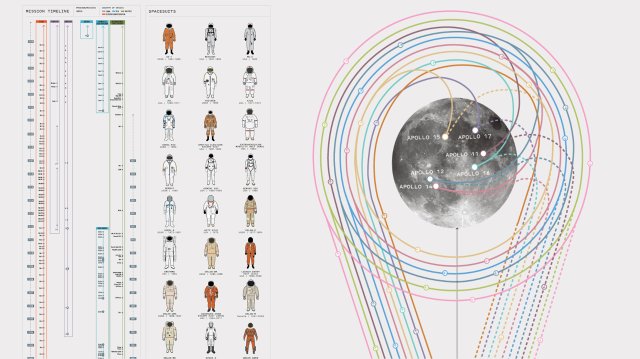
"A Visual History of Crewed Space Travel" is a poster that showcases the journey of humankind's endeavors to venture beyond Earth's atmosphere. This poster, available in Big Think's online store, is a testament to the significant milestones achieved in space exploration so far.
The poster highlights Earth's key spaceports, Moon landing sites, the farthest and highest orbits achieved by humans, and the diverse array of suits and vehicles that enabled these extraordinary journeys. The first crewed spaceflight took place on April 12, 1961, when Russian cosmonaut Yuri Gagarin embarked on his historic orbit around the planet from the Baikonur Cosmodrome in Kazakhstan.
Gagarin's successful mission not only marked humanity's first orbital flight but also spurred the U.S. to accelerate its own space program, culminating in the first Moon landing just eight years later.
Since then, the number of satellites orbiting the Earth has reached nearly 19,000, with thousands of them being inactive. Over a dozen countries now possess independent orbital launch capabilities, including Israel, Iran, and both Koreas. While crewed spaceflights have become more frequent, they remain highly prestigious and rare events.
Determining the exact number of individuals who have ventured into space depends on the definition of "outer space." According to the Fédération Aéronautique Internationale (FAI), the international record-keeping body for spaceflight, this begins at 100 km (62 miles) above sea level, known as the Kármán line. Under this definition, approximately 650 people have journeyed to space.
However, using the threshold recognized by U.S. entities — 80 km (50 miles) above sea level — the number swells to include flights of the X-15 rocket-powered plane and the space tourist voyages.
Notably, in 2021, William Shatner, best known for his role as Captain Kirk in Star Trek, became the oldest person to travel to space. Despite his famous persona, Shatner's experience aboard Blue Origin's New Shepard rocket was profoundly emotional, evoking a sense of vulnerability and wonder at the thin blue line of Earth's atmosphere. The phenomenon of experiencing such emotions upon viewing Earth from space is known as the "overview effect."
Constrained by the limited space within a spacecraft, astronauts must make the most of the available area. Early spacecraft, such as the Mercury capsules, were incredibly small, barely larger than an ejection seat. Even the Gemini capsules, with roughly the interior volume of a compact car, offered limited room. Nonetheless, longer-duration missions like Gemini 7, which lasted almost 14 days, tested humans' ability to endure extended periods in such confined spaces.
As mentioned in the poster, weightlessness played a significant role in optimizing the utilization of available space.
Space stations have played a crucial role in enabling sustained human presence beyond Earth. Skylab, America's first space station, constructed around a converted Saturn V rocket stage, provided ample room for astronauts to float around and work in separate areas for sleeping, eating, and conducting scientific experiments. Today's International Space Station (ISS), hosting nearly 300 of the approximately 700 individuals who have ever been in space, boasts an internal pressurized volume comparable to that of a Boeing 747. This impressive structure represents humanity's most extensive off-world habitat thus far.
Despite facing tragedies, slow periods of progress, and differing demographics, space exploration continues to advance. SpaceX's pioneering work in reusable rockets and potential future missions to Mars hold promise for the future of space travel. Additionally, the once-dominant space race now features multiple nations, with China having actively sent people into space for over two decades.
Looking ahead, it is probable that the demographics of future space travelers will differ from those of the early pioneers, reflecting a broader representation of the global population.
Written by urgent.news from Big Think's reporting — not their text. Machine-written — may contain errors; check the original before relying on it.