What Can Happen When a Rapidly Spinning Star Meets a Black Hole?
Astrophysicists at Syracuse University in New York think they've found a hitherto-hidden explanation for strange activity during so-called repeating partial Tidal Disruption Events (rpTDEs). These are interactions between a supermassive black hole and a star that wanders too close for comfort, but not close enough to get swallowed up.
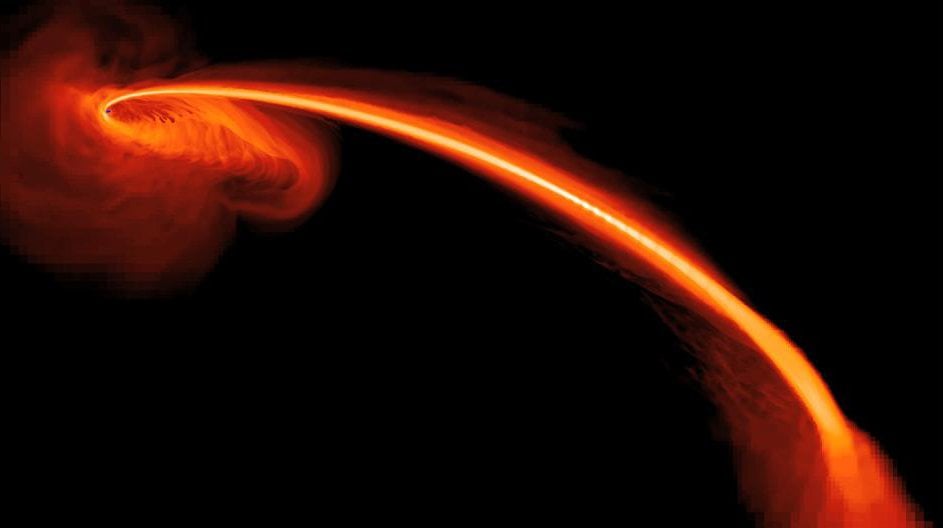
Astrophysicists at Syracuse University have proposed a new explanation for the dimming flares observed during repeating partial tidal disruption events (rpTDEs). These events occur when a supermassive black hole interacts with a star that comes too close for comfort, causing the star to lose mass and create a visible flare that gradually fades away.
While low-mass stars are more susceptible to mass loss, higher-mass stars tend to lose material from their outer layers without being entirely consumed by the black hole. However, four out of ten observed repeating flare events had dimmer flares than expected, which mass loss alone could not explain. The researchers then turned their attention to the star's spin rate, finding that rapidly spinning stars maintain a constant rate of mass loss during each encounter with the black hole.
This constant mass loss results in dimmer flares over time. The team suggests that some stars around the Milky Way's supermassive black hole, Sagittarius A*, may be tidally captured fast-spinning stars from binary pairs. These stars retain high spin rates and could exhibit the observed dimming flare behavior as they orbit closer to the black hole.
Written by urgent.news from Universe Today's reporting — not their text. Machine-written — may contain errors; check the original before relying on it.