Through The Economic Lens: Hey! Homo Sapiens, What’ve We Done?
Mumbai: AUGUST closes today, quietly withdrawing another 31 days from the one account no Homo sapiens can replenish: time. Tempted to turn the page? Another war. Another warning. I don’t care. Bills arrive, loans demand repayment, targets follow employees home and phones refuse to sleep. Wars become notifications between breakfast and work. Sometimes “I don’t care” simply means: “I have too much…
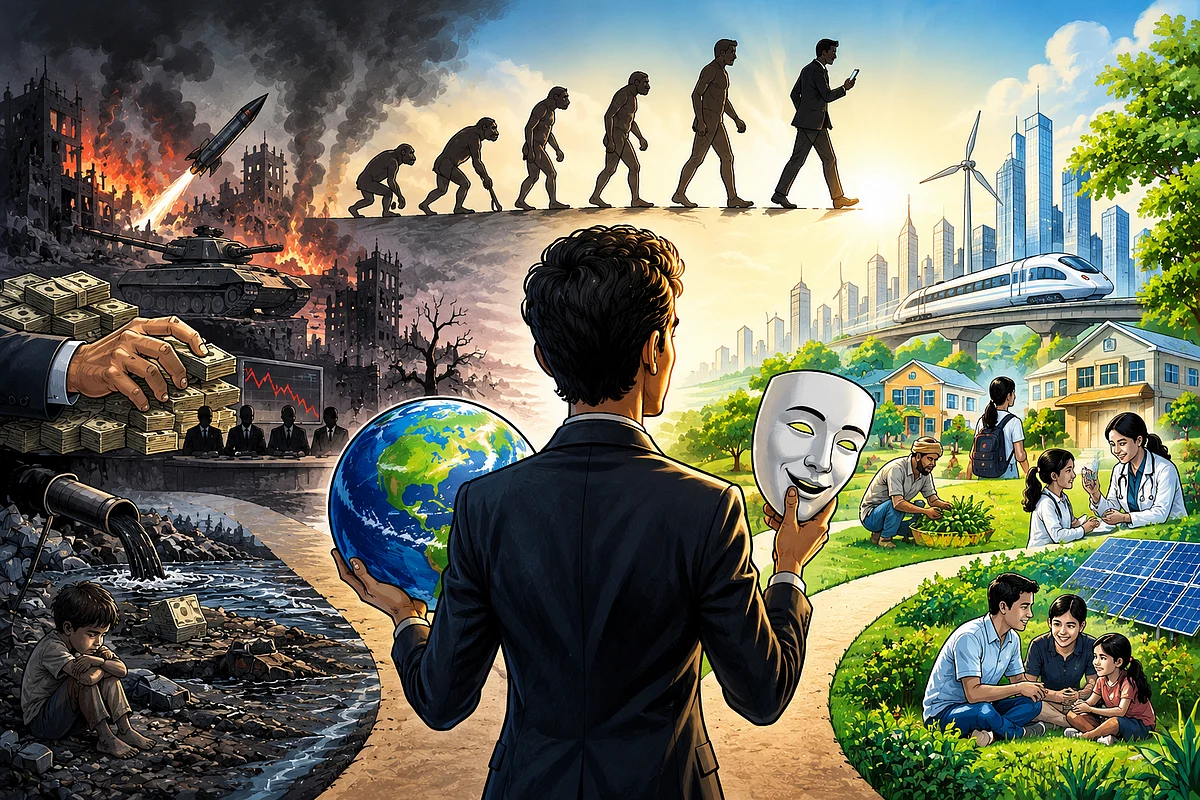
As the month of August closes, life continues to march on, with each passing day a reminder of the finite nature of human time. The world is riddled with challenges, from ongoing conflicts to economic tensions, all demanding attention and resources. Unlike nature's strongest creatures, Homo sapiens stands out for its remarkable ability to cooperate, imagine, and create institutions based on trust.
However, this same capacity for cooperation has also led to the creation of complex systems that can be manipulated for personal gain, resulting in costly failures.
Every August, the world embarks on a sobering exercise of auditing humanity's balance sheet. The numbers represent real human costs, whether in the form of lives lost in wars or the erosion of trust in economic institutions. For instance, the U.S.-Israeli war on Iran has already resulted in at least 7,900 deaths, with a staggering cost to the United States alone of $37.5 billion.
Meanwhile, trade tensions have driven up oil prices, with Brent crude surging from $72.48 to $120.88 a barrel in just six months, causing significant economic disruption.
As societies strive to become more developed, questions arise about the true progress being made. Is economic growth truly benefiting all members of society, or is it merely widening the gap between the haves and the have-nots? The Reserve Bank of India, for example, must ensure the credibility of its monetary policies while maintaining market trust and simplifying administrative procedures. Similarly, stock exchanges must safeguard investors' interests and uphold the dignity of those who rely on them for a living.
Looking to the future, advances in artificial intelligence and robotics hold the promise of abundance, but they also concentrate power in the hands of a few. Will these technological breakthroughs lead to a wiser, more equitable world, or will they simply amplify existing inequalities? The rarest asset in today's economy may be life itself, as the vast expanse of human history has been marked by struggle, conflict, and the relentless pursuit of power.
Despite our incredible technological achievements, we still grapple with fundamental questions about how to live together in a finite world. The most significant development deficit of our time may not be in technology, but in wisdom. As we navigate the complex interplay of economics, politics, and human behavior, it is crucial to remember that the ultimate balance sheet of development and peace hinges on our ability to cultivate wisdom and understanding.
Before dismissing concerns with a casual "I don't care," it is essential to recognize that we are all already on this journey, and the choices we make today will shape the world we leave for future generations.
Written by urgent.news from Free Press Journal's reporting — not their text. Machine-written — may contain errors; check the original before relying on it.