Reading Firaq Gorakhpuri's Hindustani Poetry In These Volatile Times
One of the greatest Urdu poets of the last century, Raghpati Sahay ‘Firaq’ Gorakhpuri was born on August 28, 1896. Firaq (meaning 'separation' in Urdu) is bracketed with the three Fs of Urdu poetry of the 20th century: Faiz Ahmad 'Faiz', Ahmad Faraz, and ‘Firaq’. In these polarised times when even languages are being branded on the basis of religion, sects, and provinces, studying the poetry of…
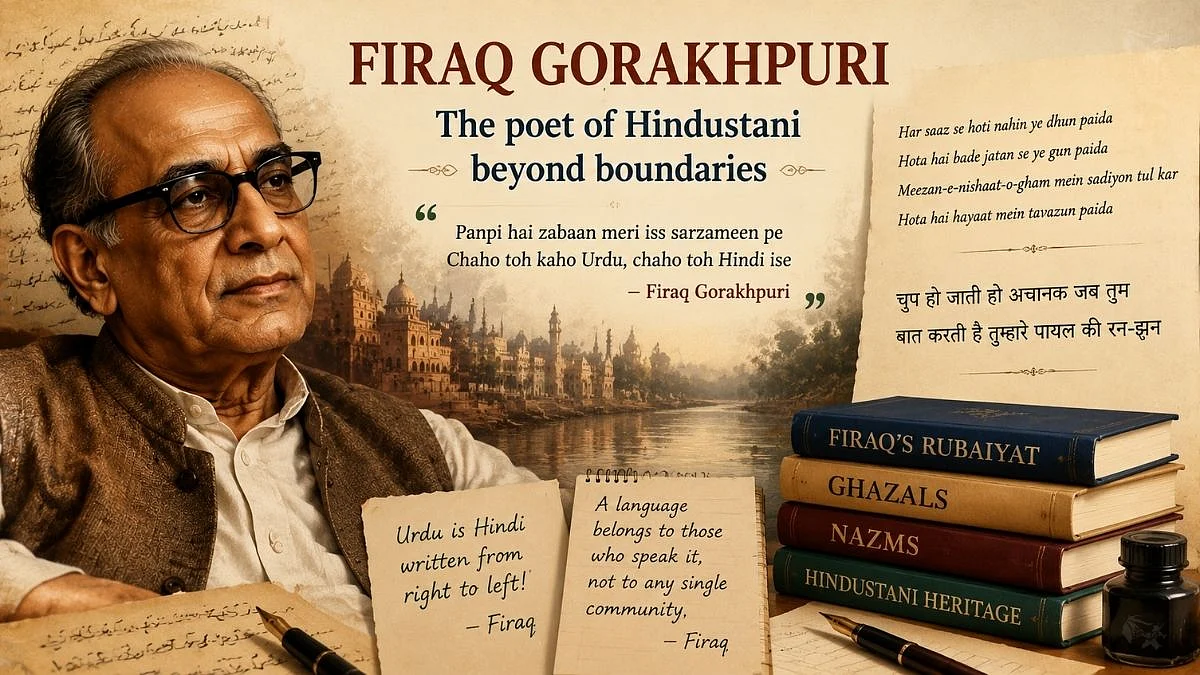
Raghpati Sahay ‘Firaq’ Gorakhpuri was born on August 28, 1896, and is considered one of the most prominent Urdu poets of the 20th century. The poet’s name ‘Firaq’, meaning separation, reflects the thematic focus of his work in the polarized times of the 20th century, when even languages were being associated with religion, sects, and provinces.
Studying his poetry is not just important, but essential to dispel linguistic misconceptions that have lately overshadowed our spirit, society, sanity, and sensibility. Despite being fluent in Urdu, Firaq never exhibited linguistic chauvinism, as he wrote equally well in English and Hindi. While teaching English literature at Allahabad University, he seamlessly wrote poetry in Urdu, English, and Hindi, without insisting on using archaic Persianised Urdu.
He believed in Indianizing Persianised Urdu and reducing it to intelligible Hindustani, as expressed in his famous statement, “My language has thrived on this soil / You can jolly well call it Hindi or Urdu.”
Firaq opposed Sanskritized Hindi and advocated for a Hindustani language that was free from the ornate ghazals and Iranian traditions. He made significant contributions by introducing Hindi words such as salonapan, chanchalpan, baalpan, and aneelapan into the Urdu language. This blend of Hindustani resulted in a seamless texture of Urdu-Hindi poetry.
Firaq firmly believed that a language belonged to those who spoke it, not to a specific community, faith, or group. He strongly opposed the idea of Hindi for Hindus and Urdu for Muslims, stating that this linguistic insistence is not new and gained prominence post-India’s independence in 1947.
Firaq’s poetry showcases a unique fusion of Hindi and Urdu words, continuing the tradition of Indian folklore, nature, and romantic idioms within the traditional Urdu structure. For instance, in one of his rubaiyat, he skillfully used Hindi words like mad (wine), raat (night), and lay (hue, shade, tune) in a way that doesn’t appear forced.
These verses resonate with both refined literary circles and general readers due to their deep connection to the composite, everyday stream of Hindustani. His work inspired Dushyant Kumar, a prominent figure in Hindi ghazal, who admired Firaq’s simple yet effective poetry.
Written by urgent.news from Free Press Journal's reporting — not their text. Machine-written — may contain errors; check the original before relying on it.