Immobilien: Mit diesen Tricks verdrängen Eigentümer ihre Mieter
Die Stadt Frankfurt hat ein bundesweit einmaliges Konstrukt geschaffen: Mit der Stabsstelle Mieterschutz berät sie bedrohte Hausgemeinschaften gegen teils perfide Methoden von Eigentümern.
Kai Schönbach, a Frankfurt city official, enjoys a panoramic view from the 12th floor of the Frankfurt Housing Authority building. The view encompasses Westend University Campus, inner-city and West City high-rise towers, the Federal Bank, and the distant Feldberg. However, Schönbach cannot fully appreciate this view due to his role as the Head of the Housing Authority's Tenancy Protection Division.
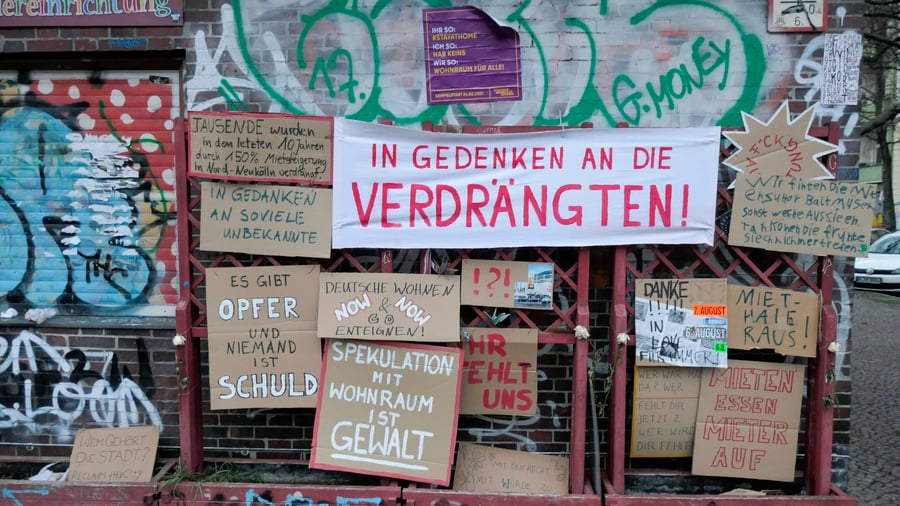
He advises housing communities under threat of displacement – tenants facing involuntary evictions due to rising rents, renovations, or conversions. In Schönbach's eyes, where others see desirable neighborhoods, he perceives tenant hardship. Tenancy displacement has become a growing problem within Germany's housing market. To address this issue, the city of Frankfurt established the Tenancy Protection Division seven years ago, a unique municipal institution in Germany.
Schönbach is well-versed in the methods landlords use to increase rents or evict tenants, as well as how tenants can defend themselves. Since 2019, Frankfurt has had the Tenancy Protection Division, which advises threatened housing communities and mediates between tenants and landlords. The existence of this division reveals much about the dysfunctional housing market in German metropolises: a market where some landlords deliberately evict tenants to rent out older apartments at a higher price or sell at a profit.
Schönbach has witnessed these tragedies throughout his career. For thirteen years, he ran a tenant rights law firm in Frankfurt's downtown, and now, as the division head, he advises entire housing communities. His team aims to resolve conflicts before they reach court. In Frankfurt, for instance, in 2013, two real estate entrepreneurs purchased a multi-family building with ten apartments in Wingertstraße 21 in the Ostend district.
They sought to renovate, increase density, split the property into owner-occupied units, and subsequently resell it. To evict tenants, the speculators kept the building under construction for years, removing windows from the staircase, and often cutting off heating and hot water. When sections of the roof were opened for the planned expansion, rain entered the apartments.
An 80-year-old resident had to endure the Christmas holidays in a bathroom with water up to her knees. Simultaneously, tenants received invalid eviction notices and eviction lawsuits. The landlord-tenant struggle persisted for nearly six years before the last tenant moved out in February 2019. "That was the climax of the Frankfurt housing market," Schönbach remarks.
As a response, the city established the Tenancy Protection Division. A case like the one in Wingertstraße should not recur. The task is not easy, as the knowledge and power disparity between tenants and landlords is significant. Many tenants are unaware of their rights, and some avoid consulting tenant associations or law firms due to the costs, believing they have no chance.
The Tenancy Protection Division aims to bridge this gap by providing free advice. Four employees – three law graduates and a vocational administration specialist – work here. The division contacts tenants by phone or email for consultations on tenancy rights and impending displacement. They offer monthly open office hours in various districts for advice on tenancy law and threatened displacement.
The division also participates in community meetings and city festivals. During major construction projects, the division attends tenant assemblies and information events. "We work deliberately not just at the table," Schönbach explains. His day often extends past nine or ten o'clock at night, as he travels through the districts.
The work begins when a property is sold or a renovation is announced. When heating or water is cut off for weeks, or an unreasonable rent increase is deemed illegal, or multiple residents report the same problems. If the landlord's action appears to be a deliberate displacement practice, the team investigates documents, clarifies rights and deadlines, and discusses next steps.
However, the division cannot take on mandates. It cannot write letters on behalf of tenants or represent them in court. For legal representation, tenant associations and lawyers are required. Tenant associations are concerned about competition. Initially, some were skeptical about the city's free advice being a significant competitor.
However, they quickly realized that they complement each other. While the division addresses displacement, unreasonable renovations, and entire housing communities being evicted, the tenant associations represent individual tenants against landlords and housing management outside of court. The division refers tenants to the association for extra-judicial representation.
In turn, the division recommends the association for extra-judicial representation when tenants need it. The collaboration between the city's administrative bodies, such as building inspection or the housing office, is facilitated by the tenant associations when landlords violate publicly regulated rules. When tenants need extra-judicial representation, the division recommends the association.
Written by urgent.news from Handelsblatt's reporting — not their text. Machine-written — may contain errors; check the original before relying on it.
This story
This is one outlet's version. Read the fullest account.
- Immobilien: Mit diesen Tricks verdrängen Eigentümer ihre Mieter handelsblatt.com