Ancient Pottery Carries a Magnetic Fingerprint That May Expose Forgeries
Learn about a new magnetic testing method that can help authenticate ancient clay relics and fight against black market antiquities.
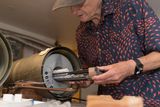
In the world of antiquities, a recent study has unveiled an innovative method for verifying the authenticity of ancient pottery. This breakthrough could serve as a powerful tool in distinguishing genuine historical relics from modern forgeries. The technique hinges on the Earth's magnetic field and its complex interaction with clay artifacts.
The study, published in the Proceedings of the National Academy of Sciences (PNAS), reveals that when raw clay is baked in a kiln, the magnetic signals from its mineral particles align with the planet's magnetic field at that moment. As the clay cools and solidifies, these signals are locked into place, a phenomenon known as thermal remanent magnetism.
However, the smaller particles within the clay continue to shift with the planet's changing magnetic field, creating a distinct secondary magnetic signature called viscous remanent magnetism.
To ascertain if an artifact is a forgery, scientists needed a way to distinguish this secondary magnetic noise from the primary signal. Researchers tested a wide array of clay objects, ranging from millennia-old authentic artifacts to modern replicas and confirmed fakes. They subjected the samples to incremental heating in an oven, with temperatures ranging from 122 degrees Fahrenheit (50 degrees Celsius) to 234 degrees Fahrenheit (112 degrees Celsius).
Earlier attempts to use magnetic analysis for artifact authentication were thwarted by the limitations of older computers, which could not simulate the behavior of magnetic particles over long periods. However, by combining their lab experiments with advanced micromagnetic computer models, the research team found that if an artifact is more than 1,000 years old, its viscous magnetism can only be erased at temperatures above 234 degrees Fahrenheit (112 degrees Celsius).
In contrast, modern ceramics lose their magnetic memory at much lower temperatures, making it easy to differentiate between ancient and recent forgeries.
This new technique offers a promising solution to the age-old problem of forgeries in the antiquities market. Museums and art historians can now use this method to authenticate disputed artifacts before displaying them, ensuring that visitors see genuine historical treasures. Moreover, the technique provides concrete scientific evidence that can be used by law enforcement and legal authorities to prosecute cases of illicit looting and art forgery.
Written by urgent.news from Discover Magazine's reporting — not their text. Machine-written — may contain errors; check the original before relying on it.