An Egyptian Tomb's 4,000-Year-Old False Door Reveals How the Living Honored the Dead
Learn how a false door, ritual offerings, and later burials trace centuries of changing funerary practices at Saqqara.
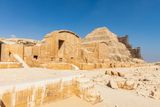
In Saqqara, Egypt, archaeologists unearthed the remnants of a funerary chapel belonging to Sekhentyu-Ptah, an official who lived during the Old Kingdom of Egypt, which spanned roughly 2649 B.C.E. to 2150 B.C.E. The tomb, over 4,000 years old, possessed a doorway that remained unaltered, with a collection of inscribed alabaster ritual objects arranged before it. Nearby burial shafts contained human remains and items from later burials, indicating that people revisited this part of Saqqara even after Sekhentyu-Ptah's era.
Mohamed Abdel Badie, head of the Egyptian Antiquities Sector, stated that the complete ritual set found together in its original position provides researchers with significant evidence of how Old Kingdom funerary ceremonies were conducted, as reported by Egypt’s Ministry of Tourism and Antiquities. Sekhentyu-Ptah's hieroglyphs offered more than his name; they served as a résumé of sorts.
He served as a royal chamberlain, overseer of the king's works and documents, guardian of royal secrets, supervisor of scribes, and priest of Maat. While the ministry did not specify the ruler he served or the specific dynasty, his titles imply that Sekhentyu-Ptah held a position near the heart of royal authority.
The objects within his chapel included an offering table and disk, a purification basin, a pitcher, and a washbasin, according to The Met. Ancient Egyptians believed that placing offerings before false doors allowed the spirit of the deceased to receive sustenance. The research team discovered the artifacts during their initial excavation season at an area just west of the Bubasteion, an ancient burial ground at Saqqara.
The site, which once served as one of Memphis' cemeteries, holds monuments from various periods of ancient Egyptian history, including Djoser's Step Pyramid and the pyramids of Fifth and Sixth Dynasty rulers.
During the excavation, the team also found evidence from a later period, including painted cartonnage, pottery, a wooden falcon statue, and three closed stone sarcophagi. Despite past robberies that had damaged other sections of the burial complex, the sarcophagi remained untouched when discovered. The discovery of over 100 faience ushabti figures—small, Egyptian-made statues buried with the dead to perform labor in the afterlife—may provide insight into the Late Period, which began over 1,400 years after the Old Kingdom ended.
To distinguish different periods of activity, researchers are documenting each archaeological layer, documenting the site through architectural records, photography, and digital tools, and conducting linguistic studies to compare the objects with finds from other parts of Egypt. This work aims to eventually be shared with peer-reviewed journals, while excavators anticipate more structures and artifacts remain beneath the surface.
Written by urgent.news from Discover Magazine's reporting — not their text. Machine-written — may contain errors; check the original before relying on it.