Do you love twilight? The 3 stages explained
Twilight is that magical time between sunlight and darkness. Astronomers, experts on nighttime, recognize 3 stages of twilight. The post Do you love twilight? The 3 stages explained first appeared on EarthSky .
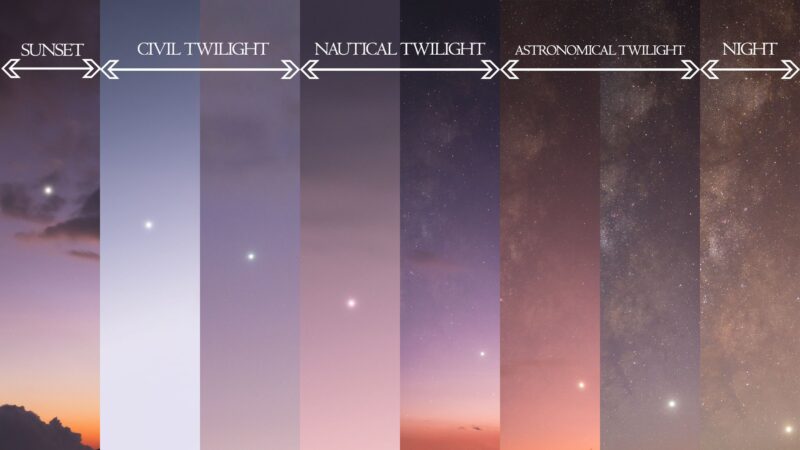
Twilight is a mesmerizing period between day and night, when sunlight and darkness coexist. Astronomers distinguish three stages of twilight: civil, nautical, and astronomical.
Civil twilight marks the beginning right after sunset. During this stage, the sun is 6 degrees below the horizon, casting a soft glow that allows visibility for outdoor activities. Planets like Venus appear brighter during civil twilight, and the boundary between day and night appears gradual rather than abrupt.
Nautical twilight succeeds civil twilight. Here, the sun resides between 6 and 12 degrees below the horizon. As the name implies, nautical twilight signals when the sky is no longer distinguishable from the sea, making stars more visible. This period was crucial for sailors in the past, as it aided navigation through the positions of stars. In polar regions, nautical twilight persists throughout the night, while mid latitudes experience it for about half an hour in spring, winter, and fall and nearly an hour in summer.
The third and final stage of twilight is astronomical twilight. In this stage, the sun is 12 degrees or more below the horizon, signaling the end of any residual illumination. Astronomical twilight is ideal for stargazing, as it allows fainter celestial objects to become visible and provide opportunities for detailed observations. For mid latitudes, astronomical twilight can last up to an hour after sunset in summer and around 30 minutes in spring, winter, and fall.
Written by urgent.news from EarthSky's reporting — not their text. Machine-written — may contain errors; check the original before relying on it.