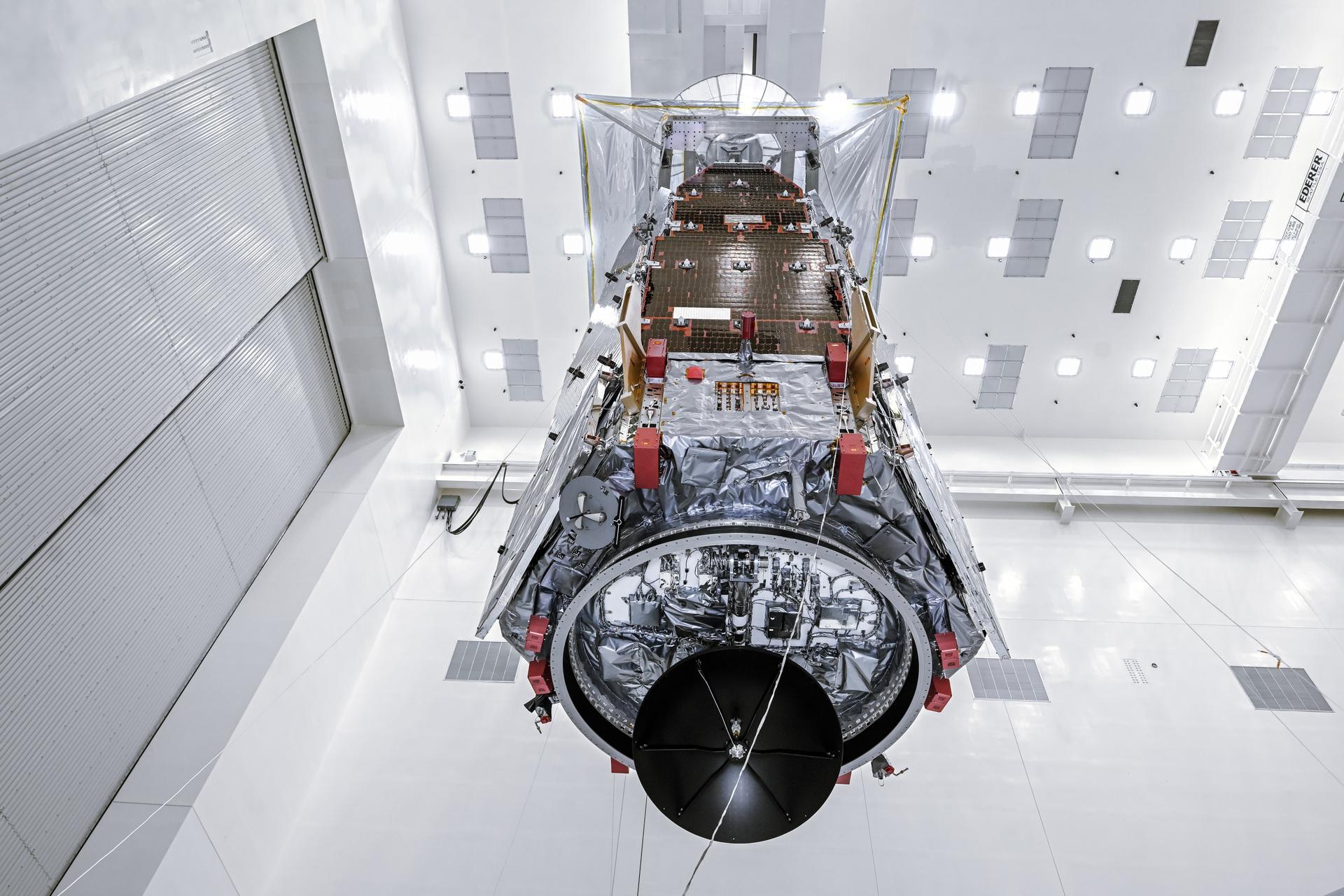
Roman Space Telescope promises 300-megapixel views of the cosmos
The $4.3 billion telescope is expected to discover tens of thousands of exoplanets while probing the nature of mysterious dark matter and energy.
NASA's Roman Space Telescope, slated for launch on Sunday, will revolutionize our understanding of the cosmos. The telescope, which will use a donated Hubble-class mirror originally intended for a spy satellite, boasts a 300-megapixel wide-field camera that will capture ultra-sharp images of the universe.
The Roman Space Telescope's data collection capabilities are unprecedented, with the telescope expected to gather 2,500 terabytes of information in just five years, a pace 1,000 times faster than its predecessor, the Hubble Space Telescope. Roman's comprehensive view of the universe will be instrumental in studying dark matter, dark energy, and the structure of the cosmos.
Dark matter, the mysterious substance that pervades the universe, holds galaxies together and accounts for most of the mass in the cosmos. Roman will help scientists gain statistically significant insights into dark matter's nature and behavior. Additionally, the telescope will work to resolve the Hubble Tension, a discrepancy between the strength of dark energy in the early universe, as measured by probes studying cosmic background radiation, and Hubble observations of supernovae, which suggest a different value.
Roman's wide-field camera will also enable the detection of exoplanets, particularly those resembling Jupiter. By analyzing the reflected light from these planets, researchers may be able to determine their elemental composition. With its advanced capabilities and unique vantage point at Lagrange Point No. 2, the Roman Space Telescope promises to open a new window on the universe and accelerate our understanding of its fundamental nature.
Written by urgent.news from CBS News's reporting — not their text. Machine-written — may contain errors; check the original before relying on it.
This story
This is one outlet's version. Read the fullest account.
- Will new telescope Roman help reveal long-kept secrets of the universe? Q&A with an expert phys.org
- NASA is preparing to launch the Nancy Grace Roman Space Telescope. Here's what to know pbs.org
- NASA’s Roman telescope will see 100 times more sky than Hubble sciencedaily.com
- NASA launches powerful Roman Space Telescope, a spy satellite turned to the stars dailymaverick.co.za
- Liftoff! NASA's Roman Space Telescope soars to the stars on a SpaceX Falcon Heavy rocket in spectacular launch (video) space.com
- Roman Space Telescope launch today: Livestream details, when to watch mashable.com
- NASA’s Nancy Grace Roman Telescope launches to space scientificamerican.com
- SpaceX launches NASA's $4.3B Roman telescope to probe dark universe seekingalpha.com